Whole-Body MRI for Preventive Screening in Healthy Adults
Popular whole-body MRI outpaces evidence that screening healthy adults actually saves lives.
Whole-body MRI has moved from a narrow clinical tool into something people buy the way they buy a gym membership, and the shift happened faster than the research needed to back it up. The exam shows up in longevity clinics, executive health packages, and direct-to-consumer storefronts, almost always without a doctor's referral and never covered by insurance. Demand did not follow new clinical guidance. It followed a cultural turn toward constant health surveillance, the belief that more scanning must mean more safety, pushed along by marketing that speaks directly to the person paying for the test.
Social media has done a lot of the persuading. A 2025 study that looked at social media content on WB-MRI and similar tests found that the overwhelming majority of posts framed the exam positively and read as outright promotion. Fewer than one in six mentioned potential harms. A large share of the influencers posting about these scans had financial ties to the services they were praising, a detail that should shape how any reader weighs the enthusiasm showing up in a feed.
Academic medicine finds itself caught in an uncomfortable spot because of this pressure. Patients who want the scan will get it somewhere, and some radiology departments have decided that offering it themselves, with proper protocols and subspecialist readers, beats leaving the field entirely to for-profit shops. Dr. Preethi Guniganti of Weill Cornell Medical College put the choice plainly: "Patients are getting whole-body MRI by the droves, so we can either let other people perform the study in a suboptimal way, or we offer it and do the best we can." It is a response to a market that already exists and shows no sign of slowing.
None of this means the technology is a fraud or that the people buying it are being foolish. It means the commercial rollout has outrun the clinical evidence, and a reader trying to decide whether to spend the money needs to understand that gap before anything else.
What WB-MRI actually does, and what it cannot see
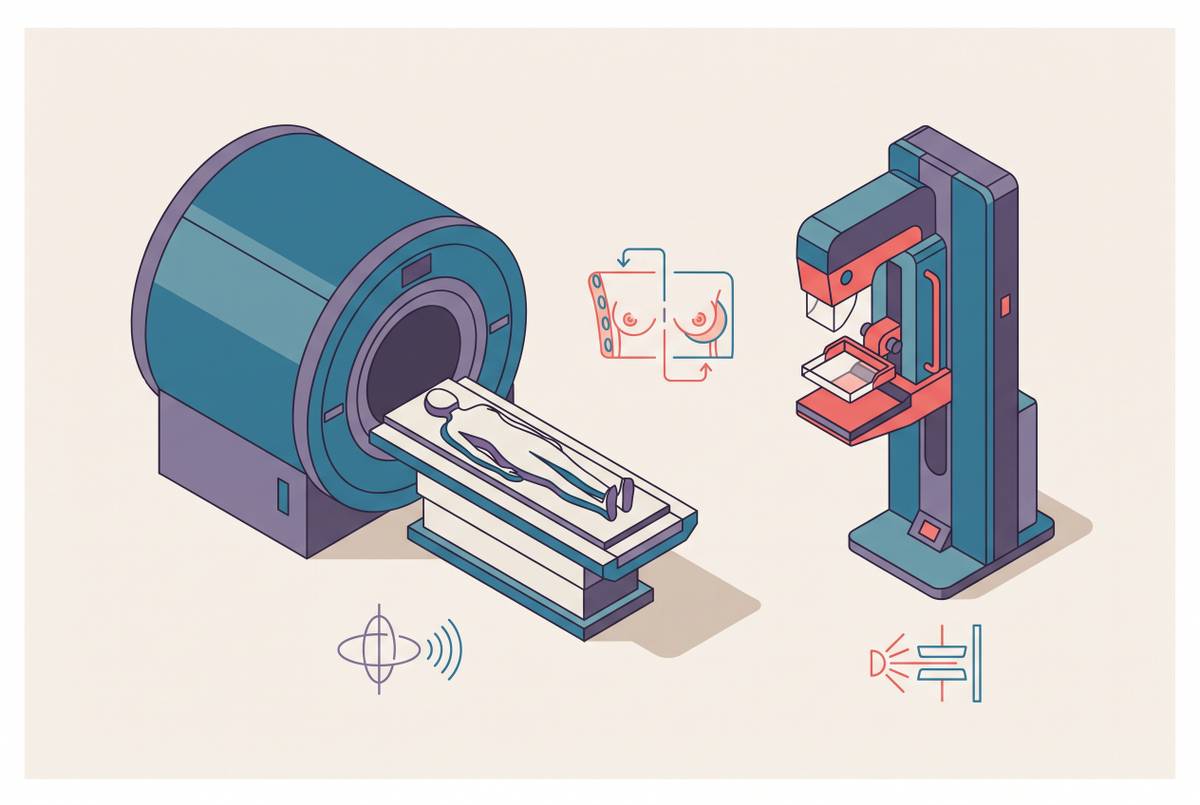
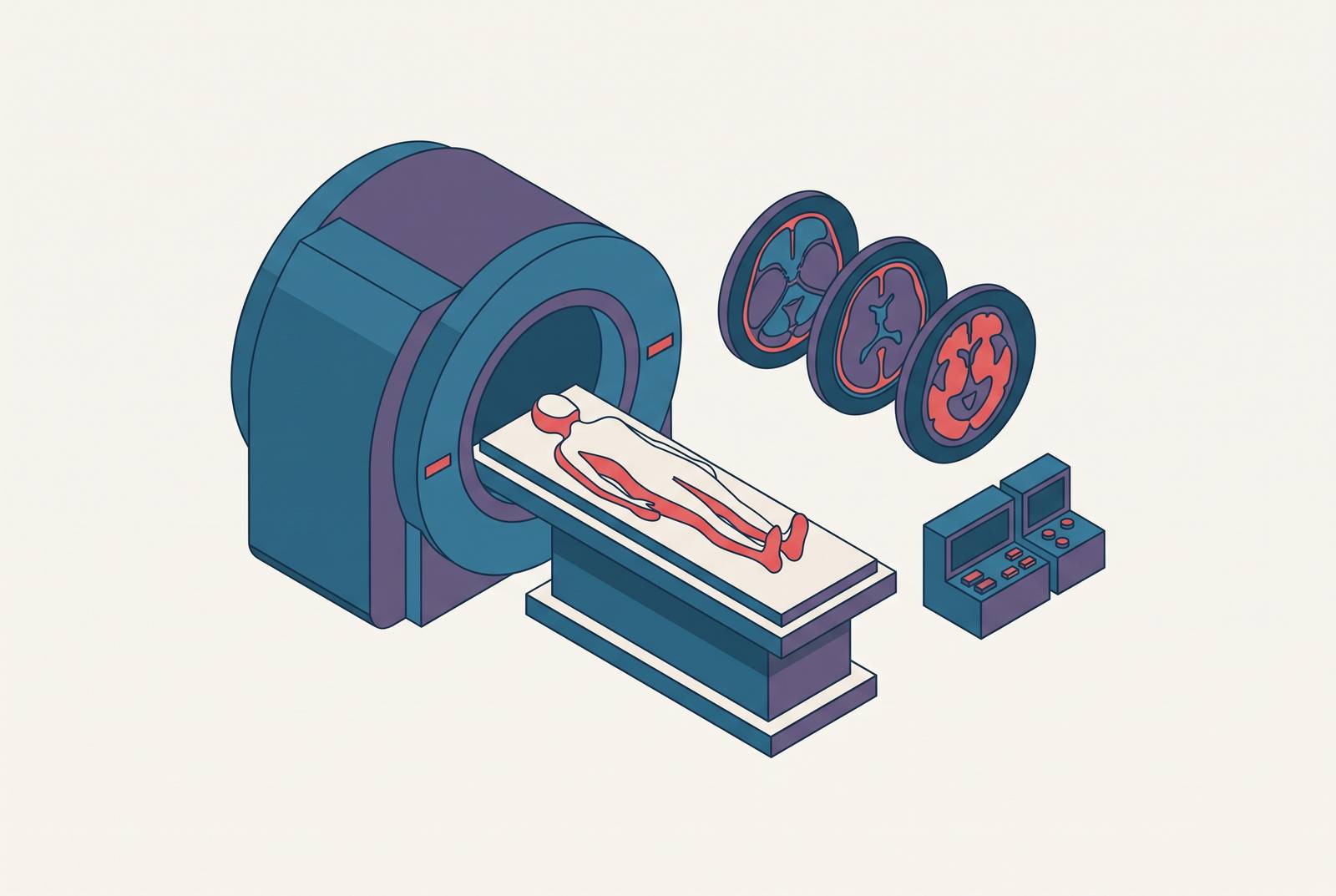
A whole-body MRI scan uses magnetic fields and radio waves to build cross-sectional images of nearly the entire body, and it skips the ionizing radiation a CT scan or X-ray involves. Protocols vary by provider, but the exam typically covers the brain, neck, chest, abdomen, pelvis, and spine in one sitting. Some academic programs add sequences built for specific risks: one program includes axial T2 FLAIR imaging, time-of-flight angiography to check for brain aneurysms, and pelvic sequences tailored for female patients. The goal is a single scan that surveys organs and tissue a patient would otherwise need several separate, targeted studies to see.
Most screening protocols skip gadolinium contrast, the injected agent that can make certain tissues and blood vessels show up more clearly on MRI. Leaving it out keeps the exam faster, cheaper, and free of the small risks contrast carries, but it also means some lesions never become visible. Some findings that eventually need follow-up appear only on contrast-enhanced sequences, so a non-contrast scan can miss something a more invasive version of the same exam would catch.
The coverage gaps extend beyond contrast. WB-MRI does not replace mammography. Prenuvo, one of the best-known direct-to-consumer providers, still tells eligible women to keep up with regular mammograms, and a share of the cancers identified in its own Polaris study were breast cancers the whole-body scan did not catch. Cardiovascular disease presents a similar blind spot. Blood pressure checks, cholesterol testing, and related measures predict the events that account for the largest share of deaths nationally, and none of that risk gets assessed by a WB-MRI scan. A clean whole-body scan tells you nothing about your heart disease risk, and that matters because so many buyers seem to treat the exam as a complete physical.
Image quality has improved. Compressed sensing techniques and deep-learning reconstruction have cut scan times and sharpened resolution, so the exam is now more comfortable and easier to offer at scale. Faster, clearer images do not answer the deeper question hanging over the whole enterprise: whether finding what these scans find actually helps the person being scanned.
What the published evidence actually shows about cancer detection in healthy adults
The clearest fact in the WB-MRI literature is also the simplest: scan enough healthy adults and the exam will find something in nearly all of them. What varies enormously, from study to study, is how much of what gets found matters, and that distinction is at the center of everything else this piece covers.
A multicenter study of 327 asymptomatic adults, read by subspecialist radiologists using the ONCO-RADS classification system (a scale built specifically to sort findings by how concerning they are), found that a substantial share of participants had at least one finding rated ONCO-RADS 3 or higher, a tier that calls for attention. Confirmed malignant lesions, by contrast, were rare. The large majority of flagged findings were classified as likely benign: the system caught a lot, and most of what it caught turned out to be nothing.
Prenuvo's own Polaris study, drawn from a large cohort made up mostly of asymptomatic participants, reported that the great majority had at least one previously unidentified finding, a notable share needed follow-up or treatment, and a small fraction turned up potentially life-threatening problems, including aneurysms and early-stage cancers. Those numbers deserve attention and a caveat in equal measure. The findings relied in part on patient-reported data, carry the kind of responder bias that affects any study where motivated participants self-report outcomes, and have not been independently replicated by outside researchers. The figures are suggestive but short of settled science.
Academic programs with tighter protocols tell a more conservative story. At Weill Cornell, in the program's first 18 months, the great majority of patients scanned had some finding, but most required no follow-up. Roughly a third had findings that called for monitoring, and only a very small fraction were malignant or suspected malignant. Internal data from another direct-to-consumer provider, covering hundreds of exams, showed that nearly all scans turned up incidental findings, but the large majority of those were classified as highly likely benign and needed no follow-up. Only a small fraction of patients needed additional diagnostic imaging, a notably lower follow-up rate than some other programs report. Biograph says standardized protocols and subspecialist reading explain that gap, and the ONCO-RADS data back this up, since they show protocol and reader expertise shaping outcomes.
What none of these studies can offer is a comparison group. No randomized controlled trial has put a WB-MRI-screened population up against an unscreened control group, and mortality data do not exist in any published study. Every number above describes what the scan finds. None of them tell you whether finding it changes how long anyone lives.
Why High Finding Rates Do Not Translate Into Proven Benefit
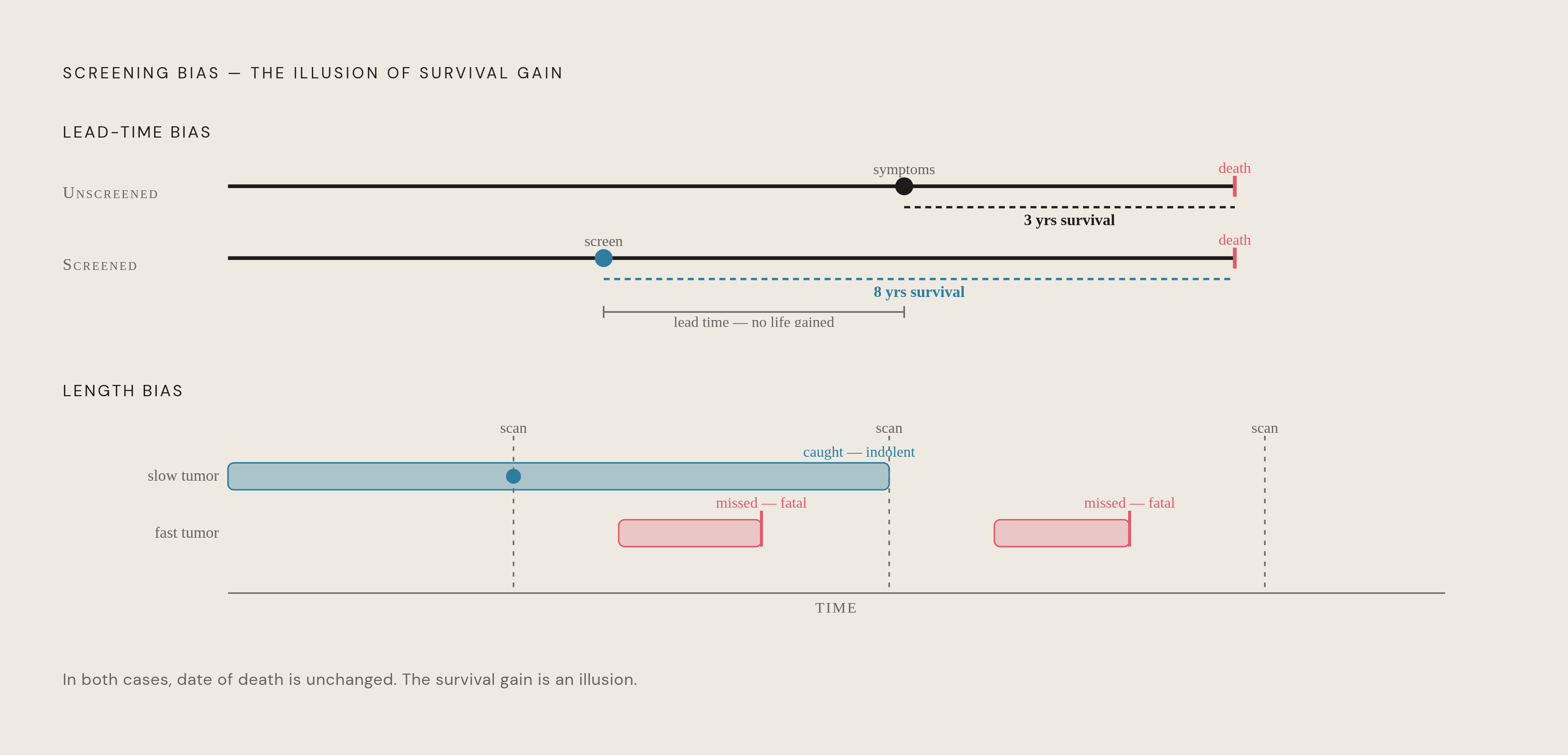
Finding a cancer earlier is not the same as stopping someone from dying of it, and the entire WB-MRI evidence base, as it stands, cannot tell the two apart. Dr. Thomas Kwee of the University of Groningen stated the problem without hedging: "Simply detecting more cancers does not mean the technique is beneficial. We know from other screening programs that you can find many more cancers and still not reduce overall mortality because many of those cancers are clinically irrelevant."
Two statistical effects explain why a screening program can look like a triumph on paper even when it changes nothing about outcomes. Lead-time bias moves the date of diagnosis earlier without moving the date of death. A person diagnosed five years before symptoms would have appeared lives with the knowledge of the disease for five extra years, and on a survival chart that looks like a win, but the person does not live a single day longer because of it. Length bias works alongside it: screening disproportionately catches slow-growing tumors, the kind that would sit quietly for years without ever threatening the patient, while the fast, aggressive cancers that actually kill people are more likely to appear in the gap between one scan and the next, invisible to a program built around periodic screening.
Then there is overdiagnosis: identifying a cancer that would never have caused harm or death if left alone. Overdiagnosis is a documented consequence of screening programs generally, not a unique failure of WB-MRI, but public conversation about it is thin. Fewer than one in fifteen social media posts across five popular medical tests, WB-MRI among them, acknowledge the concept.
Low disease prevalence compounds the problem. A systematic review of WB-MRI screening put the pooled false-positive rate at 16%, and basic statistics drive that figure, not any particular provider's sloppiness. When the population being screened has a low baseline rate of the disease, even a specific test throws off a large number of false alarms relative to true ones, because healthy people vastly outnumber sick ones in that population.
All of this leaves one question the current evidence cannot answer: do the cancers WB-MRI finds in asymptomatic adults represent the ones that would have killed those people, or the ones they would have lived alongside for decades or died of something else first? A 2026 Cochrane review protocol has been registered specifically to evaluate whether WB-MRI reduces morbidity or mortality, the gold-standard outcome any screening test ultimately has to answer for. The fact that this review is still at the protocol stage, with no completed findings yet, says something on its own: the medical establishment has not settled this question against WB-MRI, but it has not settled it in favor of WB-MRI either. The honest position is that nobody knows yet.
Supporters of the technology raise a fair point in response. The present symptom-driven healthcare system misses treatable disease all the time, and the cost of underdiagnosis has to be weighed against the cost of overdiagnosis. That argument has real force, but it is an argument for running the trials that would settle the question, not a substitute for the mortality data those trials would produce.
How incidental findings trigger a cascade that carries its own harms
Every scan that finds something incidental sets off a sequence of follow-up tests, specialist visits, and procedures, and that sequence carries costs that land on patients whether or not the original finding ever turns out to matter. Organs like the kidneys, liver, ovaries, thyroid, and adrenal glands produce incidental findings routinely: complex renal cysts, solid renal masses, hepatic lesions, complex ovarian cysts, thyroid nodules, adrenal adenomas. Most of these prove benign. Nearly all of them still open a management pathway, which can mean repeat imaging, contrast studies, or a biopsy before anyone can say for certain that nothing is wrong. Dr. Brian Dontchos of the University of Washington has pointed out that some studies suggest more than 60% of patients undergo additional imaging after an initial scan, and most of that additional imaging yields little useful information. In his words, "screening WB-MRI adds cost, anxiety, unnecessary appointments and in some cases, unnecessary biopsies and morbidity."
The physical cost of that cascade is concrete. Biopsies and procedures carried out on tissue that turns out to be benign still carry the ordinary risks of any invasive procedure, bleeding, infection, complications from sedation, and those risks are no less real simply because the biopsy comes back clean.
The psychological cost runs alongside it. Dr. Kwee has observed that "when people know there is something in their body that should not be there, it affects their work and social life." Anxiety tied to an incidental finding can persist well past the point where follow-up testing resolves the question, and that lingering effect appears nowhere in a finding-rate statistic.
A negative scan carries its own risk, running in the opposite direction. If you get a clean result, you may take that as license to dismiss other risk factors or put off symptom-driven care, particularly around cardiovascular disease, which the scan never assessed.
The costs extend past the individual patient. Dr. Manjiri Dighe of the University of Washington has noted that follow-up imaging ordered because of an incidental WB-MRI finding competes for the same MRI appointment slots that patients undergoing active cancer treatment need urgently, and that the downstream costs of all this follow-up testing burden the broader healthcare system, not just the person who paid for the original scan.
High-Risk Genetic Populations: A Strong Evidence Base for WB-MRI
The case against average-risk WB-MRI screening would be incomplete without its clearest counterexample: people carrying specific cancer-predisposition syndromes, for whom the technology's risk-benefit math works out very differently, for reasons that help explain what the average-risk case is still missing.
Clinical guidelines already support WB-MRI for several of these syndromes, where cancer detection yields run substantially higher than anything seen in the general population. That difference comes down to basic probability: when the pretest likelihood of finding a real, treatable cancer rises, the same imperfect test produces far more true positives relative to false alarms. The same 16% false-positive rate looks troubling in a low-prevalence population, but it becomes far more tolerable when the population being screened is, by definition, at sharply elevated risk.
Li-Fraumeni Syndrome offers the clearest illustration. Adults with LFS now have annual WB-MRI and brain MRI surveillance as part of the standard of care. A UK retrospective study of 75 LFS patients found that the majority of cancers detected through WB-MRI were caught at an early stage, a result that stands in sharp contrast to what the general-population data show.
The contrast matters because it names the exact condition average-risk screening has not yet met. In a high-risk population, the odds of finding a clinically significant, treatable cancer are high enough that even an imperfect test turns up more true positives than harmful false alarms. In an average-risk population, that arithmetic runs the other way, and no amount of improved image resolution or faster scan time changes the underlying probability math. Until trials like the registered Cochrane review produce mortality data for average-risk adults, the strongest evidence for WB-MRI will keep belonging to the population it was never primarily marketed to.
Sources
- Whole-body magnetic resonance imaging for cancer screening in asymptomatic adults: a multicenter study - PubMed
- Whole-Body MRI Expands, Leaving Patients Weighing Risks
- Whole-body magnetic resonance imaging for cancer screening - PMC
- Evaluation of whole-body MRI for cancer early detection in Li-Fraumeni syndrome
- Whole‐body magnetic resonance imaging (MRI) or computed tomography (CT) screening for reducing morbidity and mortality from multiple diseases in asymptomatic adults - Chen, Z - 2026
- Whole‐Body MRI Screening of Average Risk Populations: Promises and Controversies - Dai - 2026 - Journal of Magnetic Resonance Imaging - Wiley Online Library
- Whole-Body MRI Screening for Carriers of Germline TP53 Mutations—A Systematic Review and Meta-Analysis
- Whole-body magnetic resonance imaging (WB-MRI) for cancer screening: recommendations for use