Clinical AI in preventive medicine: where decision support helps and where it misleads
AI excels at imaging but risks silent errors when clinicians trust its confidence too much.
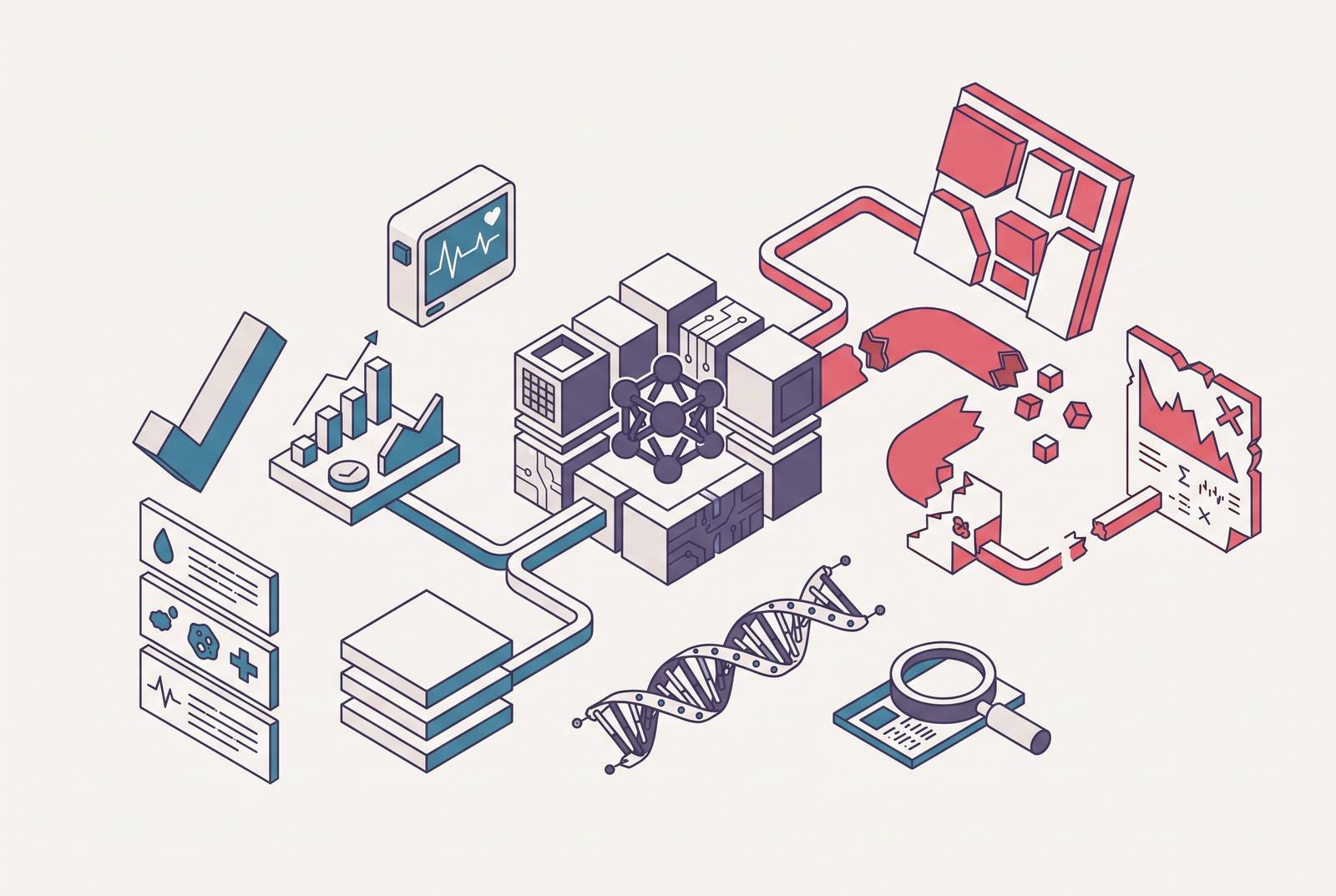
Clinical AI earns its reputation in preventive medicine. It also earns its risks there, and the risks are harder to see precisely because the setting feels routine. Anyone practicing at the intersection of technology and patient care needs to understand both sides, not as an academic exercise, but as a clinical competency. The failure modes are subtle enough that most practitioners don't recognize them until something has already gone wrong, and in preventive medicine, that moment arrives quietly: a follow-up visit three weeks later, a chart review nobody ordered.
Where the Tool Actually Earns Its Keep
The strongest use cases share a common anatomy: large, well-labeled datasets, outcomes that are objectively measurable, and a clinician who stays in the decision loop.
Imaging analysis is the clearest example. AI-assisted reading of mammograms, retinal scans, and chest radiographs has demonstrated genuine sensitivity gains, with accuracy frequently reaching the low-to-mid nineties on curated benchmarks. A radiologist reviewing hundreds of images across a long shift is subject to fatigue in ways an algorithm simply is not. The algorithm never has an off day — it just has off populations.
Cardiovascular risk stratification has matured considerably. Models trained on electronic health record data, longitudinal vitals, and lab values can surface patients who would otherwise fall through the cracks of standard screening intervals. The algorithm is not replacing clinical judgment; it is telling the clinician where to direct it.
Population-level screening prioritization is where machine learning earns value that is easy to underestimate. When a health system is managing a panel of tens of thousands of patients, a risk model that correctly rank-orders the top percentile for outreach makes clinician time allocation meaningfully more efficient. The constraint in most health systems is not data; it is the physician's finite hours — and you cannot train a model to manufacture more of those.
Where It Misleads
The problems emerge from structural realities the vendor ecosystem has strong financial incentives to minimize.
Dataset bias is the first and most pervasive. The majority of clinical AI tools were trained on data from large academic medical centers, which skew toward particular demographics, insurance types, and disease prevalences. When those models are deployed in community health settings, rural clinics, or populations that differ in any meaningful way from the training cohort, performance degrades. Silently, with no warning. The output still looks confident. It is simply less accurate than advertised, and no interface flag tells you which patients are falling outside the model's reliable range. Deploying a model trained on one population into another is like using a map of Boston to navigate Detroit: the confidence of the cartography does not compensate for the mismatch of the terrain.
Calibration drift compounds this over time. A model validated at deployment is not the same model twelve months later. Clinical documentation practices shift. Coding behavior changes. The patient population evolves. Most health systems have no robust post-deployment monitoring in place, so the model continues generating recommendations while its real-world performance erodes beneath the surface, unobserved.
The most consequential failure mode, though, is automation bias. Clinicians under time pressure defer to algorithmic outputs in ways that override their own pattern recognition. When the algorithm is right, this looks like efficiency. When it is wrong, it produces a missed diagnosis with the clinician's implicit endorsement. Research in aviation and radiology has consistently found that humans trust high-confidence outputs even when that confidence is unwarranted; the system presents certainty, and the human accepts it.
Preventive medicine is particularly vulnerable here because no single encounter feels urgent. A primary care visit is not a code blue; the clinician is on routine alert. A risk score that underestimates a patient's actual trajectory gets noted, acknowledged, and the appointment moves on. The damage is deferred.
The Calibration Problem, Specifically
Consider how preventive risk scores are actually presented in practice. A patient's ten-year cardiovascular risk comes back at eight percent. That number looks precise. It was derived from a validated equation applied to real inputs. What the interface almost never shows is the confidence interval around that estimate, how closely the training population resembles this particular patient, or how the score would shift if a single imputed variable were corrected.
Clinical AI in its current form produces point estimates when it should produce distributions. It presents output in a register of certainty that the underlying methodology does not consistently support. For a clinician who understands the model's architecture, this is manageable. For the majority who don't, it is a meaningful source of miscalibration, and nobody in the procurement conversation told them otherwise.
This is not an argument against using these tools. It is an argument for using them with a specific kind of literacy: knowing what the model was trained on, what it was validated against, and where its documented failure modes lie. That literacy is rare right now, and the industry is not rushing to close the gap.
What Good Implementation Actually Looks Like
Health systems that deploy clinical AI well treat the algorithm as a consult, not a directive. They build workflows that require a clinician to actively confirm a machine recommendation rather than passively accept it. They invest in ongoing performance monitoring tied to actual patient outcomes, not just the technical benchmarks that look good in procurement conversations. And they train clinicians on model limitations with the same institutional seriousness applied to pharmacology or procedural credentialing. In my experience, that last commitment is the first one to get cut when implementation budgets tighten.
On the vendor side, the companies doing this responsibly are transparent about training data provenance. They publish external validation results, not just internal ones conducted on the same data the model was built from. They design tools that support clinical reasoning rather than displace it, starting from clinical workflow rather than from algorithmic capability, keeping the physician's judgment central. That orientation is the difference between a tool that augments a clinician and one that quietly supplants them.
Where This Actually Lands
Clinical AI in preventive medicine is powerful, with domain-specific failure modes and a deployment context that remains immature in most health systems. The clinicians who use it well are the ones who resist both the promotional hype and the reflexive skepticism that avoids engagement entirely.
They ask hard questions about where the training data came from. They build in human checkpoints at consequential decision nodes. They treat a high-confidence algorithmic output as a starting point for inquiry, not a terminus.
The technology is not going away. The question is whether clinical culture matures fast enough to keep pace with its proliferation. In most settings right now, the honest answer is that it hasn't, and the gap costs patients something, quietly, in appointments that felt unremarkable at the time.