Polygenic Risk Scores in Primary Care Cardiology
Genetic risk scores work best for patients standard calculators can't confidently categorize.

Cardiovascular disease killed hundreds of thousands of Americans in 2023, roughly one in three deaths nationwide, and the tools primary care doctors use to catch it early were built to measure age, cholesterol, and blood pressure rather than the genetic hand a patient was dealt at conception. Polygenic risk scores are the newest attempt to close that gap: a single number, generated from a genotyping test, meant to flag lifelong cardiovascular risk before the usual clinical markers catch up. This piece argues for a specific, narrower claim than the marketing around PRS usually allows: the score earns its keep almost entirely in one place, the borderline patient a standard calculator can't confidently sort, and asking more of it than that is where the enthusiasm outruns the data.
What a polygenic risk score actually measures — and what it does not
A polygenic risk score takes hundreds, sometimes thousands, of single-nucleotide polymorphisms identified through genome-wide association studies and compresses them into one number. Think of it less like a dial and more like a chorus: no individual SNP sings loud enough to matter alone, but the combined effect produces something audible. That's the entire premise of PRS, and it's also what makes it structurally different from monogenic testing.
Monogenic variants, the kind behind familial hypercholesterolemia, are rare and high-penetrance. If a patient carries one, the mutation itself does most of the explanatory work, and testing for it is a targeted, separate exercise. PRS works differently: common variants, each contributing a tiny effect size, that only mean anything in aggregate.
Here's the part worth sitting with: the score is fixed at birth. It doesn't change as a patient ages, quits smoking, or starts exercising, reflecting a lifelong causal exposure rather than a snapshot of current behavior. A high PRS is a probability statement about risk over an unspecified time horizon; it misses monogenic disorders like FH entirely, which still need their own test. Newer multi-ancestry scores such as GPSMult were developed to address the historical underrepresentation of non-European ancestries in genetic risk research. That caveat gets its own full section later, because building a better score doesn't make it resolve itself.
How well PRS predicts cardiovascular events — what the major studies show
Start with the number cited most often: in cohorts like the UK Biobank, people in the highest PRS percentiles carry substantially greater coronary artery disease risk than those at the bottom. That's the headline figure that got PRS taken seriously as more than an academic exercise, and it's also the figure most likely to be quoted out of context.
GPSMult, published in Nature Medicine in 2023, is the most ambitious validation to date, tested across external cohorts of 33,096 African-ancestry participants, 124,467 European-ancestry participants, 16,433 Hispanic participants, and 16,874 South Asian participants. The hazard ratio per standard deviation came out to 1.73, with a tight confidence interval of 1.70 to 1.76, and about 3% of otherwise healthy people got flagged as carrying future CAD risk on par with those who already had established disease. GPSMult demonstrated strong performance across every ancestry group tested.
Now for the cautionary half, and it's the one that matters more for how a clinician should actually use this thing. A UK Biobank study of 352,660 participants found that adding PRS on top of the Pooled Cohort Equations was examined for its effect on predictive accuracy for incident CAD. A separate 2024 validation in 943 symptomatic patients with suspected CAD found the clinical-plus-PRS model reached an AUROC of 0.778 to 0.805, against 0.769 for the clinical-only model. Real, but narrow.
Line those two findings up and the pattern is hard to miss: PRS does its best work in asymptomatic, lower-risk people, exactly the population sitting in a primary care waiting room, less so in patients who've already shown up with chest pain and a cardiology referral. The asymptomatic patient is where a genetic head start matters most, and that's precisely where most of the field's excitement should be pointed instead of scattered across every possible use case.
Where PRS fits within existing risk frameworks — the reclassification evidence
The evidence points toward one narrow, useful job for PRS: reclassifying the patients stuck in risk-score purgatory, the borderline and intermediate categories where the decision to treat or wait is genuinely a coin flip.
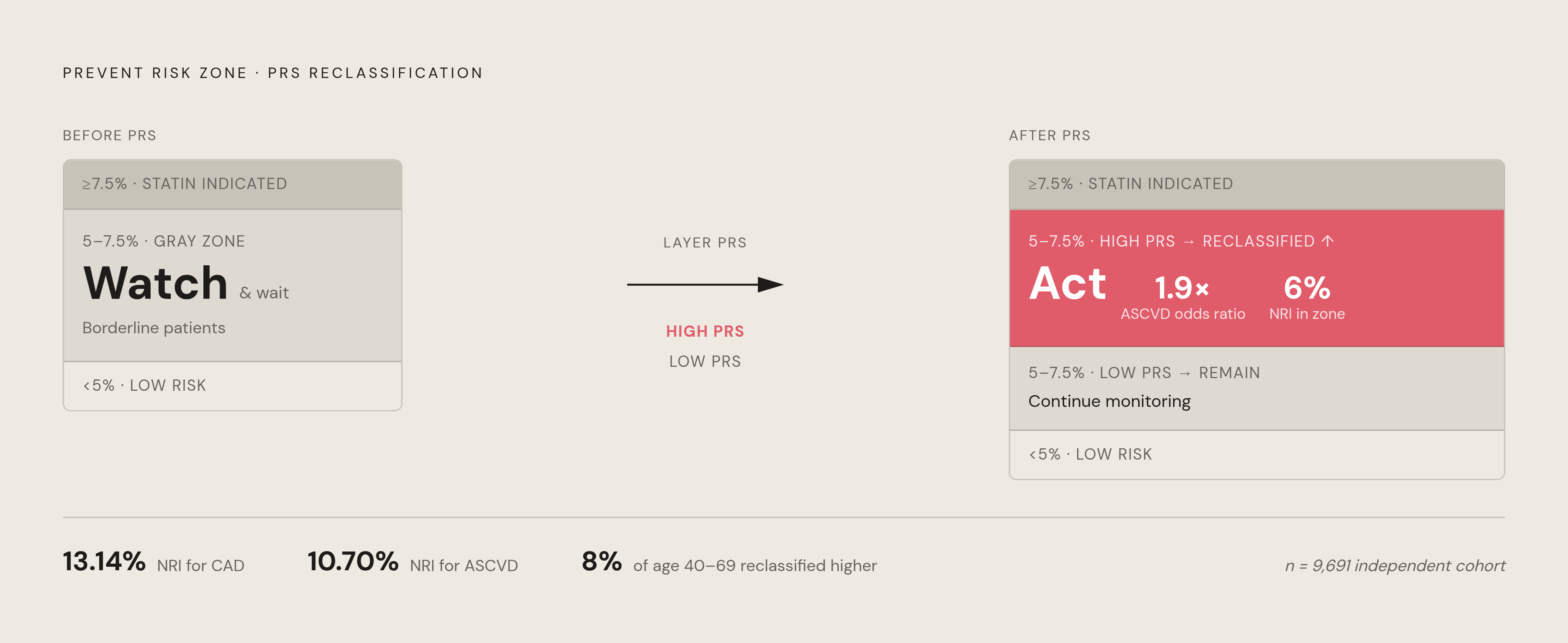
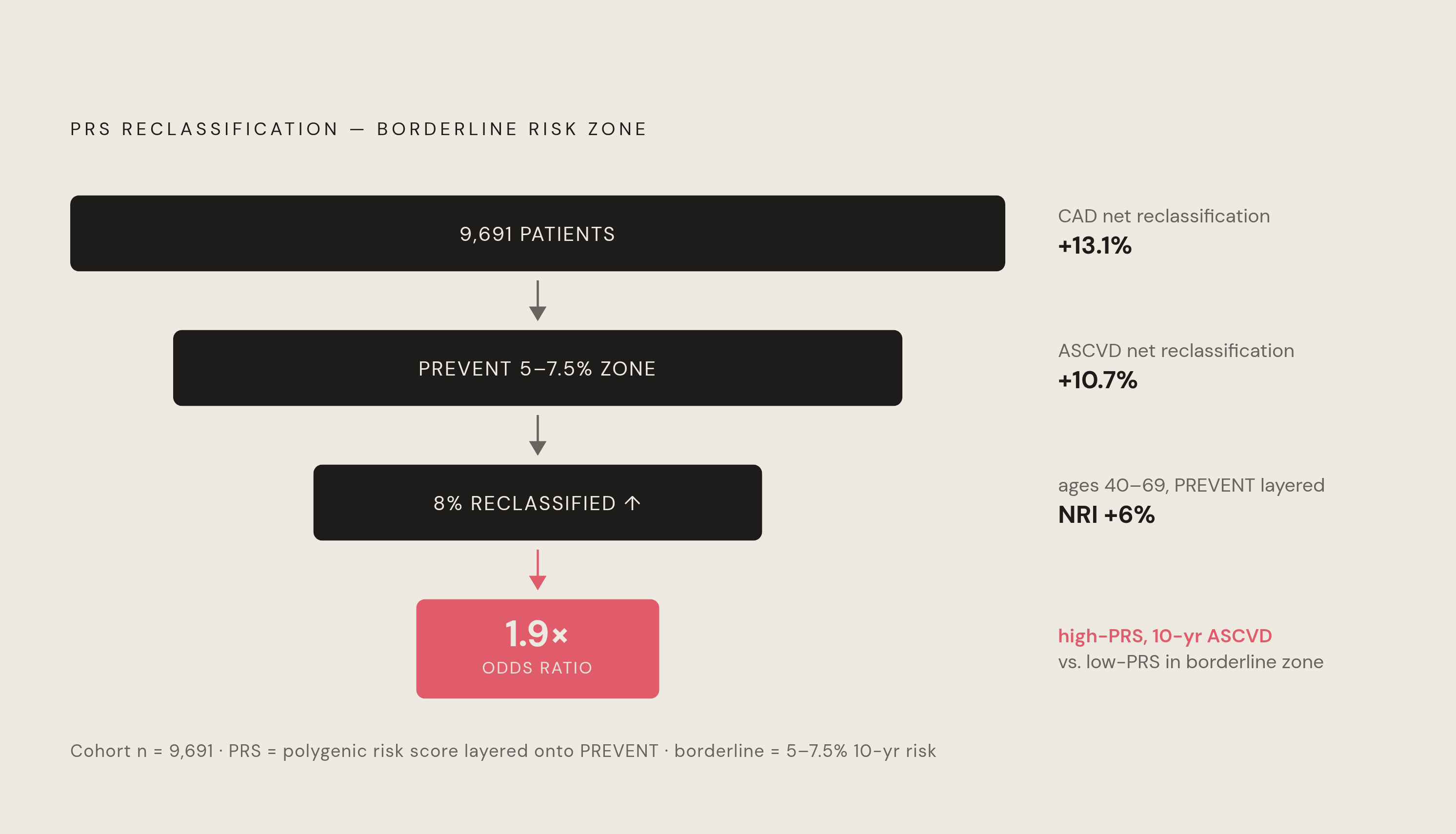
In an independent cohort of 9,691 people, using PRS to reclassify borderline or intermediate 10-year ASCVD risk improved net reclassification by 13.14% (95% CI 9.23 to 17.06%) for CAD and 10.70% (95% CI 7.35 to 14.05%) for broader ASCVD. Those aren't rounding errors. When PRS was layered onto the AHA's newer PREVENT tool, data presented at AHA 2025 by Genomics found that 8% of people aged 40 to 69 got reclassified as higher risk once PRS entered the equation. Zoom in further: among people sitting in PREVENT's 5 to 7.5% risk zone, just below the standard statin threshold, those with high PRS were almost twice as likely (odds ratio 1.9) to develop ASCVD over the following decade. Net reclassification improvement there landed at 6%.
This evidence supports a supplementary role for PRS, deployed specifically on patients who land in the gray zone those models already struggle with, and less useful elsewhere. It also pairs naturally with coronary artery calcium scoring: a high PRS can be the nudge that sends a borderline patient to get a CAC scan, and when both point the same direction, the case for action gets a lot less ambiguous.
Real-world primary care evidence — what GENVASC demonstrated
Everything above comes from cohort studies and retrospective validations, useful, but not proof that PRS survives a real clinic with a ten-minute appointment slot. GENVASC is the closest thing to that proof. The study recruited 44,141 people, 55.7% female and 15.8% non-white, through NHS Health Checks across 147 general practices in England.
The design mattered as much as the sample size: PRS got added as an integrated risk tool alongside QRISK2, delivered inside a routine health check, with no specialist referral and no separate appointment. After 195 CVD events had accumulated during follow-up, the retrospective case-control analysis found that adding the CVD-PRS to QRISK2 meaningfully improved identification of people who went on to have a major cardiovascular event. A companion acceptability study examined how the integrated tool fit within existing clinical guidance.
That younger-patient finding is the one worth underlining, and arguably the one the field undersells. Traditional risk scores lean heavily on age, so a 42-year-old with a strong genetic predisposition can look perfectly fine on paper simply because he hasn't lived long enough to accumulate the clinical risk factors those scores are built to catch. GENVASC suggests PRS catches exactly this patient, without a single genetics specialist in the building.
Expanding beyond CAD — PRS for eight cardiovascular conditions at once
Most PRS research has stayed laser-focused on coronary artery disease, which makes sense: it's the biggest killer and the best-studied. A 2026 JACC study led by Misra and colleagues shows where the field is headed next, and it's a wider net than a single condition.
Researchers built and validated integrated PRS for eight cardiovascular conditions at once, using genotype and clinical data from 245,394 participants in the All of Us Research Program: coronary artery disease, atrial fibrillation, type 2 diabetes, venous thromboembolism, thoracic aortic aneurysm, extreme hypertension, severe hypercholesterolemia, and elevated lipoprotein(a). External validation in 53,306 participants from the Mass General Brigham Biobank showed solid discrimination and appropriate calibration across all eight, not just the flagship condition.
The study calls these "clinically orderable," language that signals the infrastructure to run multi-condition panels already exists. That's genuinely interesting for primary care: one genotyping test could inform a conversation about atrial fibrillation, diabetes, and aortic disease risk in a single visit. It also means the clinician ordering that test now has eight interpretive problems instead of one, which is either an efficiency gain or a headache, depending entirely on how good the reporting tools turn out to be.
How PRS findings translate into treatment decisions, particularly around statins
Here's where PRS stops being an academic curiosity and starts bumping into an actual prescription pad. Patients with high PRS aren't just at higher baseline risk; the higher underlying genetic hazard suggests there is more risk available to modify through cholesterol-lowering therapy. That tracks: a bigger underlying genetic hazard just means there's more risk available to modify.
Which brings back the PREVENT 5 to 7.5% zone. The standard statin-initiation threshold commonly cited sits at a commonly referenced risk cutoff, and the odds ratio of 1.9 for high-PRS patients sitting in the 5 to 7.5% PREVENT risk zone makes the miss concrete instead of theoretical. These are patients the current threshold waves through, and PRS is one of the few tools flagging that a meaningful share of them probably shouldn't be waved through at all.
Where PRS earns its most practical use is probably in the exam-room conversation itself. A borderline patient asking "do I really need this statin?" is asking a question that PCE and PREVENT alone often can't answer with much conviction. A high PRS gives the physician something concrete and biologically grounded to point to, and combined with imaging evidence of subclinical disease, the findings can make for a sturdier case than any single number standing alone. Still missing are validated, score-specific thresholds that say "at this PRS value, start this drug." The treatment-threshold question remains unresolved, and health systems weighing implementation must still grapple with questions of clinical utility, potential harms, and practical logistics.
The ancestry problem — why PRS accuracy is uneven across populations
This is the uncomfortable part, and it doesn't go away just because the rest of the data looks good. PRS comes from GWAS data, and the overwhelming majority of GWAS participants historically have been of European ancestry. That's a structural design flaw baked into most existing scores, and the consequence is blunt: PRS trained on European cohorts underperforms in African, South Asian, Hispanic, and other populations, several of which carry the highest cardiovascular disease burden to begin with. The tool works best on the population least likely to need the extra warning.
GPSMult validated separately across African, European, Hispanic, and South Asian cohorts, with external validation datasets spanning tens of thousands of participants in each group. But improved isn't equivalent, and the gap between "better than before" and "equally accurate for everyone" hasn't closed. GENVASC's 15.8% non-white enrollment is a solid number for a real-world primary care study, better than plenty of trials manage, but it still leaves the broader generalizability question only partly answered.
Implementation research has openly named the potential to worsen healthcare disparities as a core challenge for PRS adoption, and that the concern is openly raised says something about where the field stands. For a clinician ordering PRS today, the honest takeaway is that predictive validity rests on firmer ground for patients of European ancestry than for anyone else, and reading a score for a patient outside that group calls for real caution about what a "multi-ancestry" label actually guarantees.
What the current guideline landscape permits — and where it is silent
So what does the rulebook actually say? Less than expected, and that's not an oversight; it's an honest reflection of where the evidence sits. The main U.S. reference document on this topic is an AHA Scientific Statement that doesn't issue a yes-or-no verdict. It leaves the actual decision to individual institutions.
The ACMG followed with a "Points to Consider" statement on clinical application of PRS in Genetics in Medicine in 2023, another framework document rather than a directive. European guidelines, as of the most recent update, don't push for routine clinical use either, though a recent ESC clinical consensus statement marks a real shift: it represents movement toward an actual roadmap for bringing PRS into routine care.
That leaves most primary care physicians working in the gap between "commercially available and increasingly ordered" and "formally endorsed by a major guideline body." What the documents agree on is that PRS works best as a risk enhancer for borderline or intermediate patients, the same conceptual bucket existing guidelines already use for risk-enhancing factors such as family history. None of them provide a validated threshold, a specific PRS value that triggers a specific action. The field agrees the tool improves stratification; it hasn't agreed on what to do once that improvement shows up on the screen.
Practical implementation in a primary care setting — what the evidence says about feasibility
None of the science matters much if it can't survive contact with a real clinic schedule. GENVASC remains the clearest existence proof that it can: PRS got folded into a routine NHS Health Check, no genetics specialist required, the test got ordered, the score came back, and it sat alongside QRISK2 in the same conversation, in the same fifteen minutes.
The GenoVA trial names three structural barriers that map directly onto ordinary primary care conditions: establishing real clinical utility inside a time-constrained visit, defining what a given result should actually mean for the patient in the room, and avoiding a pattern where testing and follow-through skew toward whichever patients already have the easiest access to care. These are the same friction points that show up whenever a new diagnostic tool tries to move from research protocol into a fifteen-minute slot.
A few logistics worth naming plainly. Genotyping is a one-time cost; the score itself doesn't change over a patient's lifetime, so whatever gets spent upfront doesn't need repeating. Interpretation is the bigger hurdle: most primary care clinicians haven't been trained in genomics, and a raw PRS number without a structured report or built-in decision support is more likely to confuse than clarify. Patient communication carries its own separate skill, too; explaining a probability-based genetic score without tipping into fatalism on one side or false reassurance on the other is a real clinical competency, not something that follows automatically from handing over a lab result. The evidence so far suggests PRS can work inside primary care's existing structure without a specialist referral chain. Whether it actually will depends on the reporting tools, the training, and the guideline clarity catching up to what the science has already shown is possible, and right now, they haven't.