Pharmacogenomic Testing in Preventive Medicine Workflows
Health systems are shifting genetic drug testing from reactive fix to preventive habit.

Pharmacogenomics, PGx for short, studies how the genes a person inherits shape the way their body processes and reacts to drugs. Health systems are now moving the field from a reactive afterthought into a preventive habit: testing people before a prescription gets filled rather than after something goes wrong. That shift, and exactly where it keeps stalling, is what this piece walks through.
For decades PGx worked backward. A patient had a bad reaction, or a drug just didn't work, and someone ordered a single-gene test after the fact to explain what had already happened. The global pharmacogenomics market was valued at $5.58 billion in 2024, projected to grow at a 10.6% compound annual rate through 2034. Capital does not usually chase an idea it expects to be irrelevant in ten years, and this much of it is chasing something specific: a bet that testing moves earlier in the timeline.
Oncology is still the largest therapeutic segment, which tracks given how long PGx has been used to match cancer patients to the right chemo regimen. But pain management is growing faster, posting the highest segment growth rate, and that detail matters more than the oncology figure does. Growth is showing up in oncology, pain, and other therapeutic areas at once, rather than concentrating in one specialty chasing one use case. A preventive layer in its early innings looks exactly like this: uneven, popping up in five places simultaneously instead of marching in from one direction.
Cost is the quieter force underneath all of it, and arguably the more decisive one. Whole genome sequencing cost over $1 million in 2007; by 2024 it sat near $200 on high-throughput platforms. That is a five-order-of-magnitude collapse in under two decades, and it flips the economics entirely. One broad panel, banked once and reused for years, now beats a string of narrow reactive tests billed, scheduled, and drawn separately every time a new prescription comes up.
What the PREPARE trial established about preemptive panel testing
The strongest evidence for preemptive testing comes from the PREPARE trial, published in the Lancet in 2023, the first large-scale prospective study of preemptive pharmacogenetic testing embedded in routine clinical practice. Researchers ran it across seven European countries, enrolling 6,944 patients and testing each one with a 12-gene panel before they were prescribed anything.
Here is the number that should reframe how anyone thinks about PGx: 93.5% of enrolled patients carried at least one actionable gene variant. That figure reads like ordinary due diligence, the genetic equivalent of checking someone's blood type before surgery instead of after the bleeding starts.
The outcome data holds up too, though it deserves a closer look than most coverage gives it. Patients who got genotype-guided prescribing had a 33% lower relative risk of an adverse drug reaction than patients on standard care (21.5% versus 28.6%), and clinicians changed the prescription or dose after seeing PGx results in 70% of cases. That is measured behavior change.
Here's the honest caveat, though, because a lot of PGx coverage oversells this trial. The reduction was not concentrated in the most severe events, and the trial has attracted critical commentary questioning aspects of its methodology. The trial enrolled just 16.7% of the 41,696 patients who were eligible, the usual generalizability problem that dogs most real-world trials. And only 25.2% of those enrolled, 1,558 of 6,193 patients in the second gatekeeping analysis, had an actionable drug-gene interaction with the specific drug they were being prescribed at the time of testing.
That is a far smaller number than the 93.5% headline, and the gap between the two figures is the whole story. Nearly everyone carries an actionable variant somewhere in their genome, but only about a quarter had one relevant to the exact drug sitting in front of them that day. That gap makes the case for testing before the prescribing moment: if PGx only mattered a quarter of the time for any single drug, but the same panel result stays relevant for every future prescription across a lifetime, testing once and storing the answer wins the math easily.
How preemptive testing differs from reactive testing in practice
Reactive testing looks like this: a doctor prescribes a drug, something goes wrong or the doctor worries it might, and a single-gene test gets ordered to explain or preempt the problem. It is narrow and slow, one gene tied to one drug, always one step behind the thing it is supposed to prevent.
Preemptive testing flips the order. A multi-gene panel runs before any drug exposure at all, results land in the patient's record, and at every future prescribing event where a relevant drug comes up, the system checks the stored result automatically. Nobody has to remember to order anything in the moment. That matters more than it sounds, because reactive testing keeps failing at exactly that step, the remembering.
Gene variants do not expire, which is the whole reason this fits preventive medicine so well. A CYP2D6 result generated during a wellness visit at 45 is exactly as valid at 70. One panel, run once, can inform dozens of prescribing decisions across cardiology, oncology, psychiatry, and pain management, none of them under the time pressure of ordering a test mid-visit while a patient is already in pain and waiting on a script.
A few examples show where this pays off. CYP2D6 variants affect how patients metabolize opioids, which is why the gene sits at the center of pain management and opioid stewardship programs trying to avoid both under-treatment and overdose. DPYD testing before fluoropyrimidine chemotherapy has become a regulatory requirement in Europe; a Spanish cohort study of 2,798 DPYD test requests between 2020 and 2024 found heterozygosity in 3.15% of cases, a small share, but a consequential one given that the alternative is severe, sometimes fatal, chemotoxicity. Antidepressant selection is another use case being explored, part of a broader effort to reduce the trial-and-error cycle in prescribing.
Emerging research has tested whether preemptive PGx is feasible in ordinary outpatient primary care clinics rather than academic specialty centers, recruiting patients in primary care settings and applying multi-gene panels suited to routine clinical use. That setting is the point: proof this works where most people actually get care, with typical staffing and typical budgets.
Separately, institutional-scale preemptive profiling programs have demonstrated operational feasibility and broad patient applicability, informing how major US health systems structure their own programs.
The infrastructure that makes workflow integration possible
None of this works without three layers running together: standardized clinical guidelines, electronic health record integration, and clinical decision support alerts that fire at the right moment. Miss any one of the three and the chain breaks, usually quietly.
The Clinical Pharmacogenetics Implementation Consortium, CPIC, is the guideline backbone most of this space builds on. It maintains 28 active clinical practice guidelines spanning a broad range of clinically relevant gene-drug pairs, and its guidelines are increasingly pulled directly into EHR environments to support clinical decision-making. Outside the US, comparable guideline bodies fill a similar role in their respective health systems. Regulatory footing has firmed up as well: regulatory guidance on pharmacogenomic labeling has expanded in recent years, and evolving coverage policies alongside regulatory developments have opened somewhat clearer reimbursement paths than existed a few years ago.
EHR integration is where the idea actually lives or dies, and here's the position worth taking: a stored result that never reaches the prescriber counts as a non-functioning system, full stop. A gene variant sitting in a database nobody looks at is a fact about a patient with zero clinical consequence, which is functionally the same as not knowing it at all. EHR genomic modules matter because they surface stored genetic data at the exact moment a prescriber is writing an order, and that timing is the entire value proposition.
Alert fatigue is the hazard sitting on the other side of that coin. Physicians pinged by irrelevant pop-ups start ignoring all of them, useful ones included. A vague banner reading "pharmacogenomic result on file" accomplishes close to nothing, while a banner reading "patient is a CYP2D6 poor metabolizer, consider alternative to codeine" changes what happens next, because it tells the prescriber what to do about the result rather than merely flagging its existence.
Community pharmacy is an underused entry point here. Community pharmacy represents an underexplored entry point, and pharmacists are well positioned to catch medication issues a rushed fifteen-minute primary care visit might miss. Adoption on both the patient and prescriber side stays uneven, which is a polite way of saying the infrastructure exists in pockets rather than as one connected system.
Where implementation is actually breaking down
The science, at this point, carries little of the argument, and treating it like the crux is the mistake most PGx coverage keeps making. Systematic analyses of PGx implementation barriers in the US have identified recurring domains including equity and inclusion, payer coverage, EHR capability, and provider and patient education, among others. Notice what is missing from that list: nobody is arguing the underlying biology is shaky. The fight has moved to logistics, money, and training, a duller fight but a far more solvable one.
Clinicians are a good place to start, since this is where the gap is starkest. Most physicians in practice today were never trained in pharmacogenomics in medical school; the field was not mature enough yet when they went through. Knowing a PGx result sits in a chart is a different skill entirely from knowing what to do with it, which is exactly why CDS alerts carry so much weight. Built well, an alert does the interpretive work the physician was never taught to do. Built generic, or firing too often for irrelevant reasons, and physicians learn to click past it, turning a perfectly good test result into an expensive piece of trivia sitting unused in the record.
Reimbursement is the second snag, and arguably the one holding the whole system hostage. Coverage stays inconsistent: Coverage policy updates have clarified some indications but left plenty of others in a gray zone where hospitals are not confident they will get paid. Without that certainty, a finance team has a hard time greenlighting the spend needed to run preemptive panels on every incoming patient. It is a circular problem: broader adoption would make the cost-effectiveness case easier to prove, and proving cost-effectiveness is exactly what is needed to justify broader adoption. Neither side wants to move first, and blaming clinicians for slow uptake, which happens often in this conversation, misses that the finance office is usually the one holding up the pilot.
Equity deserves more attention than it usually gets, and here's where the draft's own numbers make the case better than any general statement could. Most PGx reference databases were built predominantly from populations of European ancestry, so variant interpretation for other groups rests on a thinner evidence base and carries more uncertainty by construction, not by accident. Testing access clusters around academic medical centers and large health systems, while primary care in underserved and rural areas lags well behind. A preventive tool that only reaches people who already have good access to care mainly benefits people who were doing fine anyway, which runs counter to what preventive medicine is supposed to accomplish in the first place.
Put it together and the picture is fairly clear: the barrier here is coordination, not scientific validity. The science works, and pieces of the infrastructure work, but routine adoption needs workflow design, reimbursement clarity, and clinician education solved at the same time rather than one after another. Solve two out of three, in whatever order, and the system still stalls.
What a functioning preventive PGx workflow looks like end to end
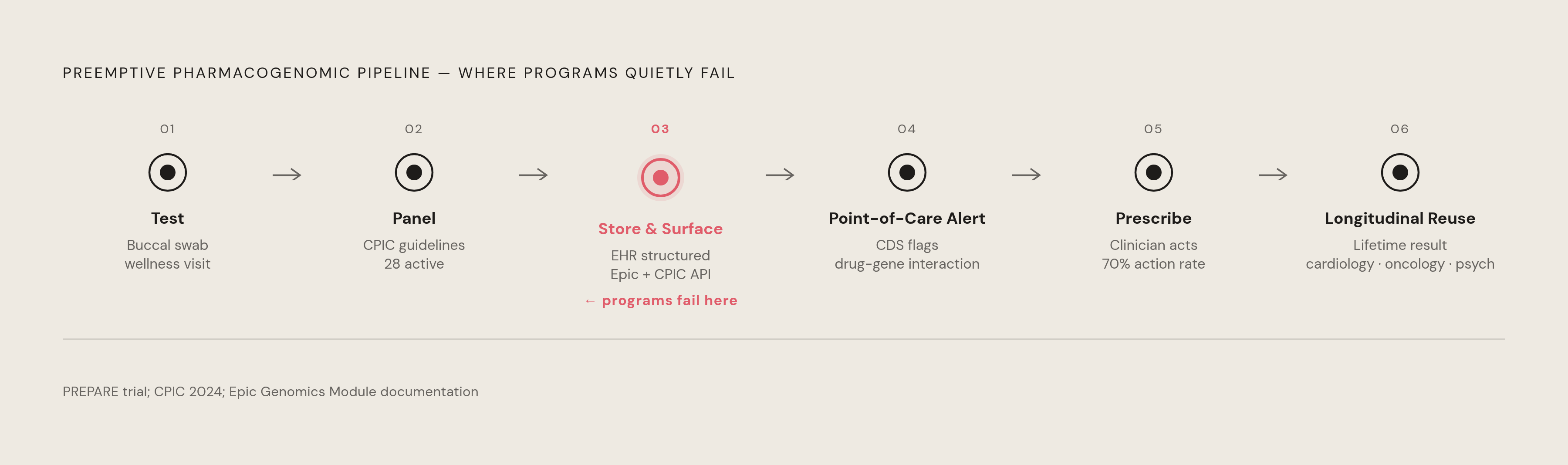
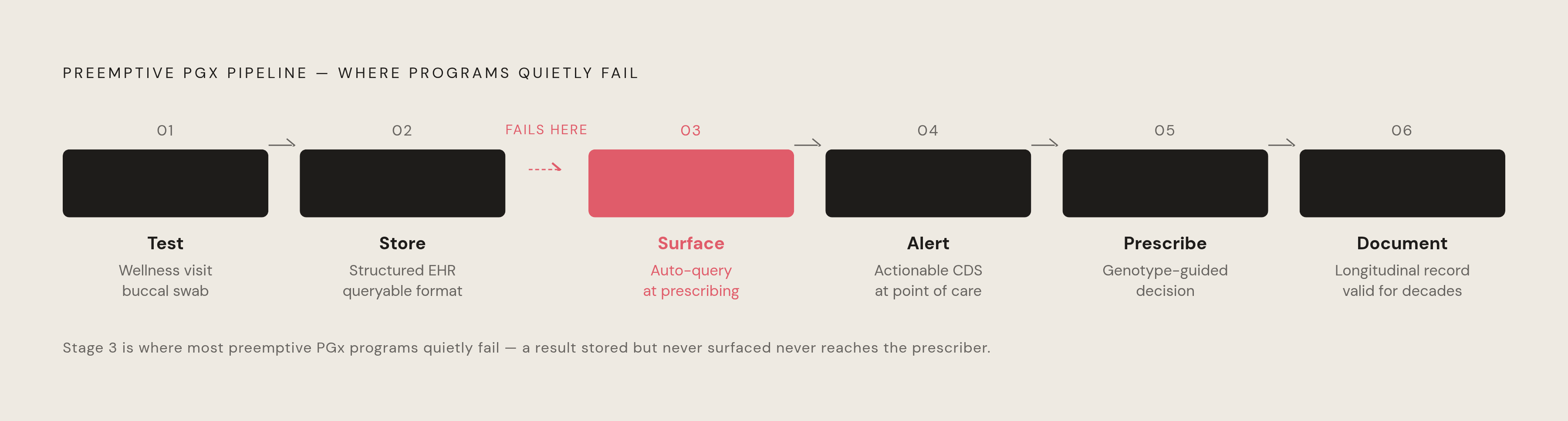
Strip away the debate and the workflow is a pipeline: test, store, query, alert, prescribe, document. Six links, and the chain is only as reliable as its weakest one, which in practice is usually the one nobody thought to inspect.
Stage 1, when to test. The most sensible windows are opportunistic ones already built into care: an annual wellness visit, new patient intake, or the start of chronic disease management. Preemptive testing programs have used concrete eligibility criteria, such as patients with a history or risk of relevant chronic conditions, or those already on PGx-relevant medications. Sample collection is a buccal swab, about as low-friction as clinical testing gets, requiring no needle and no fasting.
Stage 2, what panel to run. The panels generating the most durable preventive value cover the pharmacogenes with the widest prescribing relevance across the gene-drug pairs with established clinical guidelines. CPIC's 28 guidelines act as a practical filter, since they define which gene-drug pairs already have enough evidence behind them to justify a clinical recommendation. Testing for a variant with no actionable guidance attached provides little practical value; it's a data point without a downstream decision attached to it.
Stage 3, storing and surfacing. This is where a lot of programs quietly fail, and it's worth being blunt about why: a structured result buried as a scanned PDF nobody opens again creates the illusion the work is already done. Results need to sit in a structured, queryable format inside the EHR. Epic's Genomic Module paired with CPIC API integration is the current best-practice combination for surfacing results at the moment a prescriber needs them. CDS alert design is the make-or-break variable here: specific, actionable, tiered by urgency, or it gets ignored the way every other over-triggered pop-up gets ignored.
Stage 4, point-of-care decision support. A prescriber orders a covered medication, the system flags the relevant drug-gene interaction, and the alert links directly to an alternative drug or dose recommendation grounded in CPIC guidance. This is where PREPARE's 70% figure earns its keep: when the alert is built well and grounded in solid guidance, clinicians act on it the large majority of the time.
Stage 5, documentation and longitudinal use. PGx results do not expire, which is the whole point of the exercise. A profile entered at 40 is still accurate at 65, still useful to a cardiologist, an oncologist, and a psychiatrist the patient has not met yet. Embedding the result in the longitudinal record turns one test into a recurring asset every future prescriber can draw on, across every care setting the patient ever passes through.
Taken together, the workflow closes a loop preventive medicine has not traditionally included. Prevention used to mean lifestyle counseling, vaccination schedules, and screening tests looking for disease that has not shown up yet. Preemptive PGx adds something earlier still: knowing, in advance, how a given patient's body will handle the drugs most likely to come up over the course of their chronic disease trajectory.
What needs to change for preemptive PGx to become routine rather than exceptional
The remaining gap is structural, and structural gaps close slower than anyone would like, mostly because they need several parties moving at once rather than one lab publishing one more study everyone already agrees with.
Reimbursement clarity is the lever most health systems are sitting around waiting on, and it's the one most likely to unstick everything else if it moves first. Broader Medicare and commercial payer coverage for preemptive multi-gene panels would remove the single biggest obstacle standing between pilot programs and system-wide rollout. The cost-effectiveness case keeps getting easier to make on its own terms, too: panel prices are drifting down toward the low-to-mid four-figure range, while the cost of one preventable ADR-driven hospitalization, the kind PREPARE showed genotype-guided prescribing can avoid, sits well above what most panels cost to run in the first place. At some point that math gets hard for a finance committee to argue with, no matter how conservative the committee.
Clinician education is the other half, and it should not arrive as a stand-alone training module forgotten within a month of the mandatory-compliance email. That approach has already failed once, and repeating it while expecting a different result is not a plan. Folding it directly into the workflow itself works better. Pharmacist integration at the point of prescribing is one practical model, since community pharmacy feasibility studies already show it works in real settings, not just on paper. CDS tools need to keep absorbing more of the interpretive burden too, so a physician does not need a PGx fellowship to act correctly on a result. An alert specific enough to trust does that job instead, every time, more reliably than a training module nobody remembers past the quiz at the end.
None of this waits on a scientific breakthrough. It waits on payers, EHR vendors, guideline bodies, and frontline clinics moving in the same direction at roughly the same pace, a duller problem than sequencing a genome for $200 but arguably a harder one to solve, since duller problems rarely attract the funding that flashier ones do. The biology already knows what to do. The workflow is still catching up, and it's the workflow, more than the science, that decides whether any of this reaches the patient sitting in the waiting room right now.