What whole-genome sequencing actually changes about preventive care
Whole-genome sequencing shifts prevention from detection to genuine risk identification.
Most of what gets called preventive care is actually early detection. That distinction sounds pedantic until you sit with it for a minute, because it completely changes what we should be asking of the tools we use.
A mammogram is not preventing cancer. It is finding cancer that is already there. Same with a colonoscopy. Both matter enormously in the right circumstances. But calling them prevention is a category error we have collectively decided to live with, mostly because we did not have anything better to offer. Whole-genome sequencing changes that underlying logic, and if you are serious about your health or work in healthcare, understanding exactly how is worth your time.
Your Genome Is the Whole Book, Not a Chapter
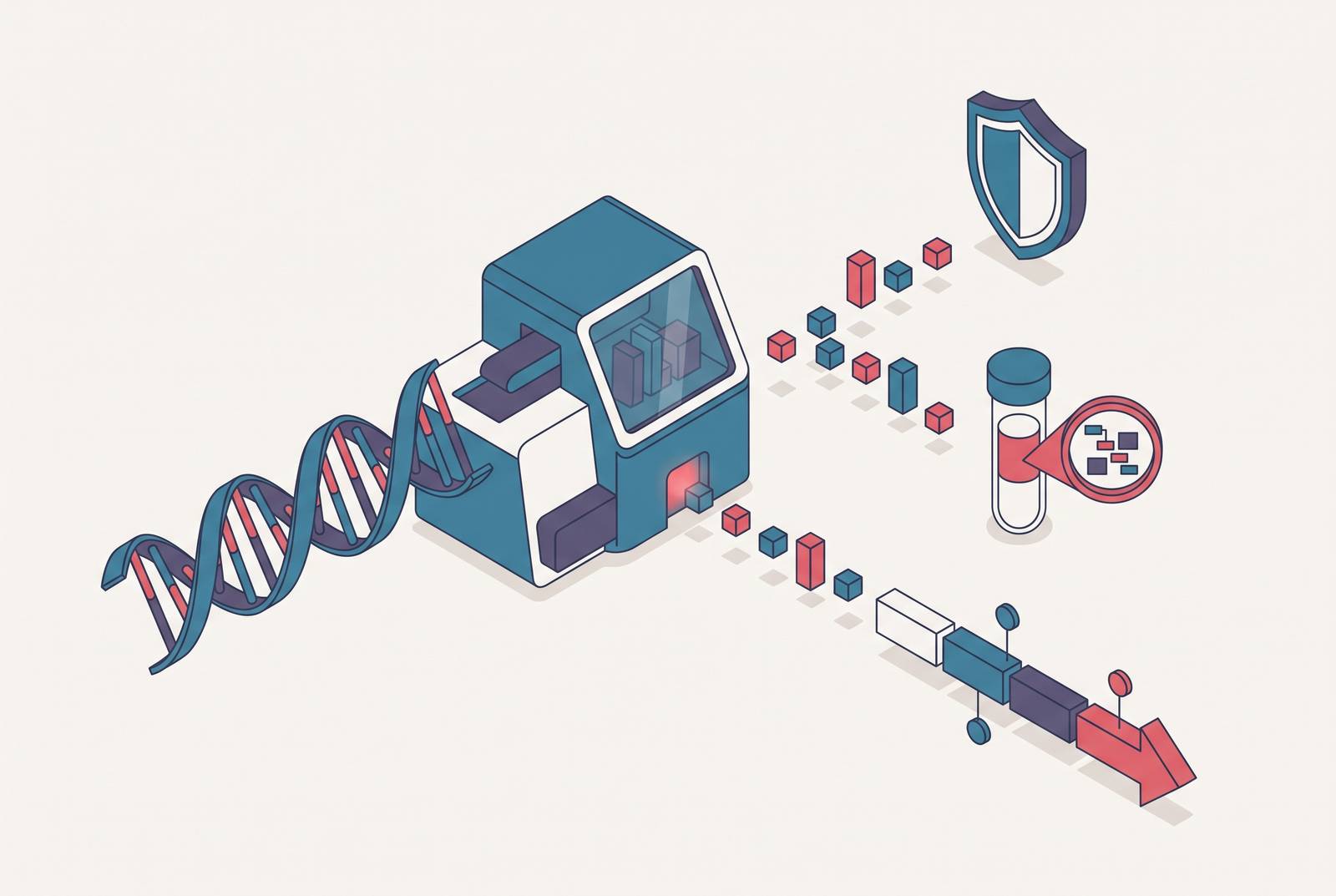
Your genome is the complete instruction set your body runs on. Every gene, every variant, every regulatory region that nudges another gene up or down. When we talk about sequencing the whole genome rather than a targeted panel, we are talking about reading all of it rather than the sections someone already suspected were relevant.
Targeted panels have been the clinical standard for good reason. They are efficient. You test for BRCA1 and BRCA2 because the science connecting those variants to breast cancer risk is mature and well-validated. The tradeoff is a kind of structural blindness: the panel cannot find what it was never built to look for. Anything outside the predefined targets is invisible, and it stays invisible.
Whole-genome sequencing drops that assumption entirely. It captures everything. And here is the part that surprises most people when they first encounter it: the sequencing only needs to happen once. As researchers identify new clinically meaningful variants, your existing data gets reanalyzed without collecting a new sample. You are not buying a snapshot; you are building a longitudinal relationship with a dataset that becomes more informative as science advances. That is genuinely unprecedented. Nothing in medicine before this worked that way.
Cascade Testing Is Where It Gets Real
One of the most concrete ways whole-genome data changes outcomes is in how familial risk gets identified and, more importantly, what families actually do about it. When a variant with clinical implications surfaces in one person, it immediately becomes relevant to their biological relatives. This is called cascade testing, and the downstream math is not subtle.
Consider a hereditary cardiac condition caught in someone in their late thirties, asymptomatic, no family history they knew about. That finding now gives their siblings and children the option to test for that specific variant. Those who carry it can begin appropriate surveillance and early intervention. Those who do not carry it can be genuinely reassured, not just told to watch and wait. That reassurance is underrated in clinical conversations. Removing years of unfounded anxiety and unnecessary testing is a real outcome, even if it is hard to capture in the metrics we typically report.
This kind of impact does not show up neatly in a single patient chart. It accumulates across families, quietly, over decades.
The Drug Metabolism Problem Nobody Talks About
If there is one application of whole-genome data that reliably surprises people, it is pharmacogenomics. Your genetic variants determine, in significant part, how you metabolize drugs. Rapid metabolizers clear certain medications before they reach therapeutic levels. Poor metabolizers accumulate the same standard dose until it becomes toxic. Neither of these people is unusual or rare. Variation in drug metabolism pathways is common, and the consequences range from a medication doing nothing to serious adverse events.
Historically, clinicians discovered this the slow way. Prescribe, observe, adjust. In psychiatry, anticoagulation, oncology, pain management, that process of figuring it out after the fact carries genuine cost. Financial cost, yes, but also real harm. With genomic data available at the point of prescribing, the decision can be informed before the first dose ever enters someone's bloodstream.
Clinical implementation here is still uneven, honestly frustratingly so. The evidence base is solid. The problem is infrastructure. Getting pharmacogenomic insights integrated into routine prescribing workflows, in a form clinicians can actually act on in a twelve-minute appointment, remains a work in progress across most health systems.
The Actual Barrier Is Not What You Think
Costs have dropped so sharply over the past two decades that price is no longer the primary obstacle for individuals or institutions that are serious about this. The friction lives downstream of the sequencing itself: how data is stored, how it gets interpreted, how it stays current as science evolves, and how it actually reaches a clinical encounter in a form that changes a decision.
This is where the offerings in this space diverge substantially. Several companies now provide whole-genome sequencing products, ranging from consumer-facing to clinically integrated. Nebula Genomics is one. Health system-affiliated programs are another category. Some direct-to-consumer companies have expanded into clinical-grade offerings. What separates the more rigorous from the rest is depth of the variant library, the quality of clinical curation, whether the platform conducts ongoing reanalysis as new evidence emerges, and whether the output connects to care or just delivers a PDF that sits in a drawer.
A genomic report is only as useful as the decisions it informs. That last mile is where a lot of products fall short, and it is the right question to press on when evaluating any offering in this space.
The Physician Readiness Gap
Many primary care physicians are not yet trained to interpret genomic data with confidence. This is not a criticism; it is a structural reality. Genomics moved faster than medical education, and the gap is real, even if it is closing through curriculum reform and through genetic counseling becoming a more integrated specialty rather than a referral-only resource.
The practical implication is to engage with whole-genome data now rather than wait for that gap to close. It is to ensure the layer between raw genomic data and the clinician is built well. Structured clinical summaries, variant classifications legible to a non-specialist, genetic counseling woven into the workflow rather than bolted on as an afterthought: these elements determine whether sequencing actually changes a care pathway or just adds an impressive document to a chart.
What It Actually Changes
Whole-genome sequencing does not offer certainty. It does not tell you definitively that you will or will not develop a given condition. What it does is shift the probability calculus your clinical team works with, sometimes modestly, sometimes dramatically. It surfaces risks that would otherwise remain invisible until they became symptomatic. It allows treatment to be personalized in ways that population-level guidelines structurally cannot achieve, because population-level guidelines are built for the average patient, and you are not average.
Preventive medicine has always aspired to act before disease establishes itself. The honest answer is that until recently, we lacked the data to actually do it. We were detecting, not preventing, and calling it something it was not. That is changing now, and the distinction is worth taking seriously.