Hereditary Cancer Risk Genes Beyond BRCA1 and BRCA2
Other inherited cancer genes rival BRCA mutations in clinical importance and screening impact.
Roughly 5 to 10 percent of all cancers trace back to a single inherited mutation, passed down the way eye color or a bad knee gets passed down: quietly, structurally, and without much say from the person who inherits it. BRCA1 and BRCA2 get the headlines, but they only explain about half of the families where a clear genetic cause can be found. The rest of the story runs through genes most people have never heard of: PALB2, CHEK2, ATM, the Lynch syndrome genes, TP53, RAD51C and RAD51D, BRIP1. This piece walks through what each one actually does, what it raises the risk of, and what a positive result should (and shouldn't) change about screening.
A 2024 review in Cancer Treatment Reviews found that BRCA testing turns up a pathogenic variant in only about 20% of people whose personal and family history looks like classic hereditary breast cancer. That gap is where the rest of this article lives. A 2025 cohort of 280 patients suspected of having hereditary breast and ovarian cancer (HBOC) found pathogenic variants in non-BRCA genes in 10.4% of patients, compared with 8.9% for BRCA1/2 combined. Non-BRCA variants outnumbered BRCA variants in that cohort. That's the headline flipping, and it's the reason multigene panels (ordering many genes at once instead of just the two famous ones) have become the standard of care rather than a nice-to-have add-on.
One concept worth carrying into every section below: penetrance. It's the term for how likely a mutation is to actually cause cancer in a person who carries it, and genes get sorted into high, moderate, and low penetrance buckets accordingly. A high-penetrance mutation is close to a guarantee; a moderate-penetrance one is more like loaded dice, still a game you can lose the normal way. That distinction drives whether a doctor recommends annual MRIs starting at 25 or just says to keep an eye on it. And as panels test more genes, doctors run into more variants of uncertain significance (VUS), mutations that show up on paper but whose actual risk contribution isn't yet known. The more genes on the panel, the more of these ambiguous results show up. Not every positive result is actually an answer, and treating a VUS like a diagnosis is one of the more common mistakes made after panel testing comes back.
PALB2: the third major breast cancer gene and what its risk numbers actually mean
PALB2 stands for Partner and Localizer of BRCA2, a mouthful that also happens to be a fairly accurate job description. The protein it encodes escorts BRCA2 and RAD51 to broken DNA strands so they can be repaired through homologous recombination, the cell's preferred method for fixing double-strand breaks without leaving typos in the genome. When PALB2 stops working, that repair pathway breaks down, and the consequences show up as Fanconi anemia in some families, breast cancer in others, and pancreatic cancer in others still.
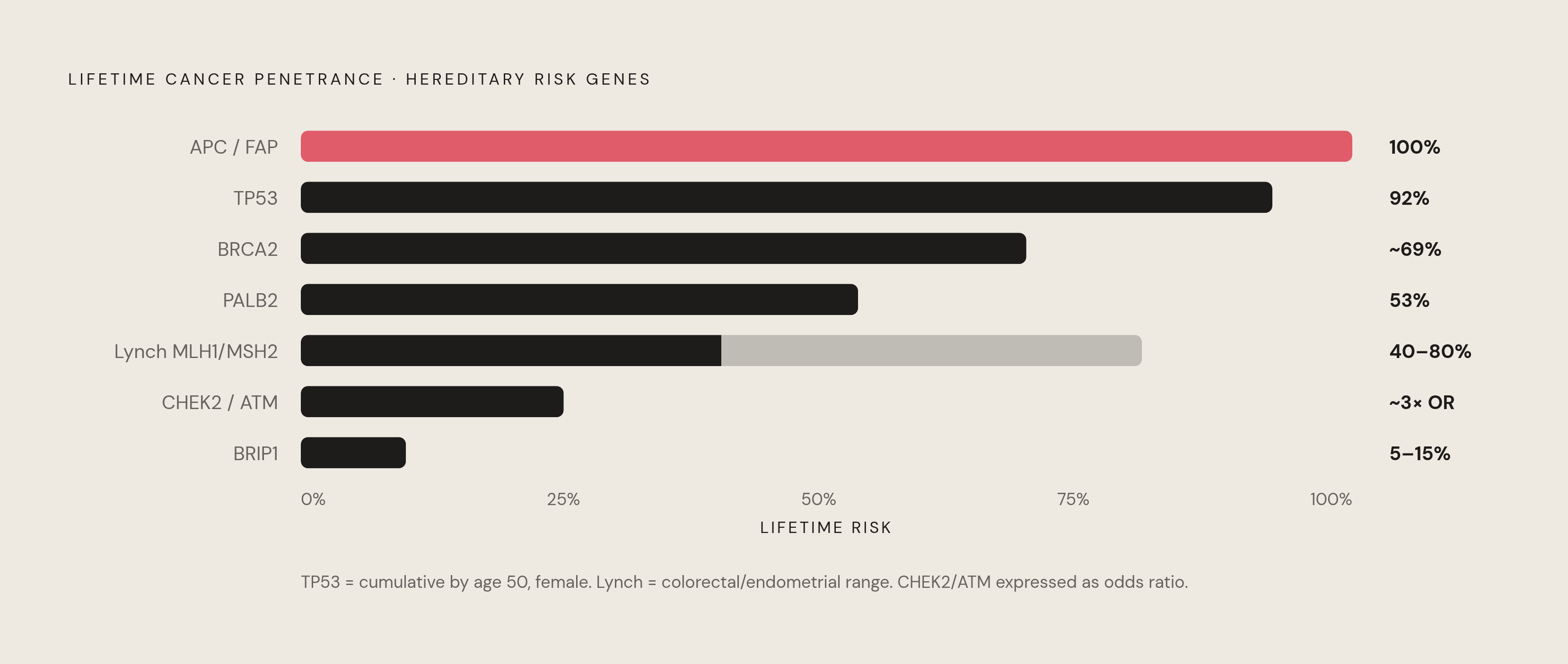
The numbers here are not subtle. Research compiled on NCBI/PMC puts the lifetime breast cancer risk for female PALB2 carriers at 53% by age 80 (95% CI, 44 to 63%), in the same neighborhood as BRCA2. That's a risk profile that changes clinical decisions, not a footnote for a family history form. PALB2 carriers also face a higher rate of triple-negative breast cancer, and worse, elevated risk of being diagnosed in the first place. Pancreatic cancer risk for carriers is meaningfully elevated above the general population baseline, though still modest in absolute terms.
Prevalence varies by ancestry in a way that matters for counseling, not just trivia. Global carrier prevalence sits around 0.18%, but that number stretches from 0.41% in Finnish populations down to 0.04% in Ashkenazi Jewish populations, a group where BRCA mutations get outsized attention precisely because they're so common there. Put ATM, CHEK2, and PALB2 together and, per a 2025 PMC analysis, they account for roughly 3% of all breast cancer cases, small as a raw percentage but nearly half of all clinically meaningful pathogenic variants found on germline testing.
Clinicians sometimes call PALB2 "the new BRCA," and the shorthand earns its keep: same repair pathway, comparable breast cancer risk, similar screening playbook (intensified surveillance, risk-reduction conversations similar to those offered to high-penetrance gene carriers). Where the nickname falls apart is pancreatic cancer. PALB2's pancreatic signal deserves its own paragraph in a counseling session, not an asterisk stapled to the breast cancer numbers.
CHEK2 and ATM: moderate-penetrance breast cancer genes with distinct risk profiles
CHEK2 and ATM both work as checkpoint kinases, molecular traffic cops that halt cell division when DNA damage is detected so the damage can get repaired before it's copied into two cells instead of one. When either gene is broken, the checkpoint fails to hold, and damaged cells keep dividing anyway. Same basic mechanism, but the two genes carry meaningfully different risk profiles, and treating them as interchangeable is where a lot of casual reporting on this topic goes wrong.
Start with CHEK2. A UK study found truncating variants (mutations that cut the protein short and usually kill its function) carry an odds ratio of 3.11 for breast cancer (95% CI 2.15 to 4.69). Data from the CARRIERS consortium found that CHEK2 carriers face an elevated risk of developing a second, separate breast cancer in the opposite breast, a detail that matters enormously when a patient and surgeon are deciding between lumpectomy and bilateral mastectomy. CHEK2 also carries a prostate cancer signal that resists easy summary: the c.1343T>G variant showed an odds ratio of 3.03 in African men (95% CI 1.53 to 6.03), while c.1312G>T showed an odds ratio of 2.21 in European men (95% CI 1.06 to 4.63). Two variants, two ancestries, two numbers, no single line that covers both. An older claim linking CHEK2 to colorectal cancer risk has since been walked back; current consensus doesn't support it, worth flagging for anyone who read an older article and filed that fact away as settled.
ATM tells a related but distinct story. Its truncating variants carry an odds ratio of 3.26 for breast cancer (95% CI 1.82 to 6.46), numerically close to CHEK2's 3.11, but the resemblance stops there. In that same CARRIERS analysis, ATM and CHEK2 carriers carry distinct risk profiles beyond the primary breast cancer odds ratios alone. That's the kind of distinction that changes whether a surgeon brings up prophylactic mastectomy of the healthy breast at all. ATM's risk profile extends beyond breast cancer, which is why a thorough family history remains important when interpreting a positive result.
Here's the part that should reshape how these two genes get talked about: two genes with nearly identical breast cancer odds ratios point toward two different surgical conversations, because one of them (CHEK2) raises the odds of a second cancer in the opposite breast and the other (ATM) doesn't. Anyone treating "moderate-penetrance breast cancer gene" as a single bucket is missing the detail that actually changes what a surgeon recommends.
Lynch syndrome: the most common hereditary colorectal cancer syndrome and its often-missed cancer spectrum
Lynch syndrome comes from pathogenic variants in one of the DNA mismatch repair genes: MLH1, MSH2, MSH6, PMS2, or EPCAM. Mismatch repair is the cell's spellcheck function, catching small errors that slip past DNA replication before they become permanent. Break that system and errors accumulate fast, which is why Lynch syndrome tumors often carry a hallmark called microsatellite instability, essentially a genomic fingerprint of a spellchecker that fell asleep at the wheel.
Lynch syndrome affects an estimated 1 in 279 people, more common in the general population than BRCA mutations, and yet it remains routinely underdiagnosed. It accounts for 2 to 4% of colorectal cancers and 0.8 to 1.4% of endometrial cancers. The mistake worth naming directly: treating Lynch syndrome as a colon cancer syndrome, full stop. It isn't, and that assumption is probably the single biggest reason it gets missed. Colorectal cancer carries a lifetime risk of 40 to 70% (against a general population risk around 4%), endometrial cancer runs 25 to 60% in women (general population around 3%), and the spectrum continues into ovarian, gastric, small intestine, urothelial, brain (typically glioblastoma), biliary tract, and pancreatic cancers, plus a distinctive pattern of sebaceous skin lesions. Carriers also tend to develop cancer earlier than the general population and face a higher chance of a second, unrelated primary tumor showing up somewhere else later.
Not every Lynch gene carries the same weight, either. MLH1 and MSH2 carry the highest lifetime risks, in the 40 to 80% range for both colorectal and endometrial cancer, and between them they account for the large majority of documented Lynch mutations, roughly 50% for MLH1 and 40% for MSH2, per the InSiGHT database. The remaining 10% spreads across MSH6, PMS2, and EPCAM, genes that generally carry lower cancer risk than their two more prominent cousins, which matters when calibrating how aggressive surveillance needs to be.
Who should get tested? Colorectal or endometrial cancer diagnosed before age 50 is a flag. So is a personal history of multiple Lynch-associated cancers, or a family tree with a cluster of them. Tumor testing showing microsatellite instability or loss of mismatch repair proteins is another signal, as is meeting the Amsterdam II criteria or the revised Bethesda guidelines, formal checklists doctors use to decide who warrants genetic testing. For confirmed carriers, surveillance is intensive: frequent colonoscopy starting at an early age, regular endometrial surveillance for women, and organ-specific screening for other Lynch-associated cancers, with exact intervals and start ages determined by the specific gene involved and family history. Risk-reducing hysterectomy and removal of the ovaries and fallopian tubes is also on the table for women done having children.
TP53 and Li-Fraumeni syndrome: when the tumor suppressor itself is broken
Li-Fraumeni syndrome comes from germline mutations in TP53, sitting on chromosome 17p13.1, first described by Li and Fraumeni in 1969, making it one of the oldest recognized hereditary cancer syndromes on this list. TP53 gets called the "guardian of the genome" because its job is to stop damaged cells from dividing, or push them toward programmed cell death if the damage can't be fixed. When that guardian is broken from birth, every cell in the body loses its primary backstop against runaway division.
The penetrance figures here are the starkest in this piece. Cumulative cancer risk by age 50 runs to 92.4% in females (95% CI 82.2 to 98.3) and 59.7% in males (95% CI 39.9 to 81.3). By age 70, that climbs to nearly 100% in females and 75% in males. Five cancer types make up the classic core of Li-Fraumeni syndrome: soft-tissue sarcomas, osteosarcomas, brain tumors, premenopausal breast cancer, and adrenocortical carcinoma, an otherwise rare cancer of the adrenal gland that shows up disproportionately in this population. Female carriers face a 63.3% cumulative risk of breast cancer by age 50 alone, and those tumors skew heavily toward HER2-positive disease, showing up in 67 to 83% of TP53-related breast cancers versus 16 to 25% in the general population. A genuinely distinct clinical subtype, not just an earlier-arriving version of ordinary breast cancer.
And Li-Fraumeni syndrome doesn't stop at one cancer per carrier. The risk of a second primary cancer runs as high as 50%, and multiple malignancies show up in 43% of carriers over a lifetime, which turns "cancer survivor" into a somewhat premature label for a lot of these patients.
What sets Li-Fraumeni syndrome apart from everything else here isn't just the numbers, it's the clinical logistics. Because core cancers include childhood tumors like adrenocortical carcinoma and pediatric brain tumors, surveillance for confirmed carriers begins well before adulthood. surveillance protocols for Li-Fraumeni syndrome lean heavily on MRI wherever possible, given the particular concerns that arise with repeated imaging in this population. Combine high penetrance with genuine rarity, and plenty of clinicians outside major cancer centers will go an entire career without knowingly treating a case. That's precisely how underdiagnosis persists even for a syndrome this well-documented.
RAD51C, RAD51D, and BRIP1: the moderate-penetrance ovarian cancer genes that extend the HBOC picture
More than 20% of ovarian cancer cases trace back to some inherited genetic predisposition, and BRCA1/2 explain only a portion of that share. A 2025 ACMG clinical practice resource classifies RAD51C, RAD51D, and BRIP1 as the next tier down: moderate-penetrance genes that, after BRCA1 and BRCA2, matter most for ovarian cancer risk, together contributing to roughly 2% of ovarian cancer cases overall.
Broken down individually: RAD51C pathogenic variants show up in 0.6 to 1.2% of the general population and in about 1% of ovarian cancer patients. RAD51D runs similarly, at 0.4 to 1.8% population frequency and roughly 1% of ovarian cancer patients. BRIP1 sits at 0.6 to 0.9% population frequency, with a lifetime ovarian cancer risk for carriers estimated at 5 to 15%, a real elevation over baseline but nowhere near the certainty that shows up later in this piece with APC.
RAD51C and RAD51D don't stop at ovarian cancer, either. Both carry a moderate breast cancer risk as well, and the tumors that show up skew toward the triple-negative subtype, the same pattern already seen with PALB2 and BRCA1. That overlap is a reminder that these genes aren't operating in separate silos. They're variations on a theme, mutations disrupting the same broad category of DNA repair machinery, just at different points and with different downstream consequences.
Worth naming the gap plainly: a substantial share of the familial relative risk in ovarian cancer remains unexplained by any gene currently on a testing panel. BRIP1, RAD51C, RAD51D, and the Lynch syndrome mismatch repair genes together account for a modest share of hereditary ovarian cancer. Most of the inherited risk in ovarian cancer is still unmapped, and that's less a knock on current science than an honest acknowledgment of how much remains to be found. Clinically, a positive result in any of these three genes triggers a conversation about ovarian cancer surveillance and risk-reducing salpingo-oophorectomy (surgical removal of the ovaries and fallopian tubes), but because penetrance sits in the moderate range rather than the near-certain range, the timing and intensity of that plan gets worked out case by case instead of following one fixed protocol.
APC and familial adenomatous polyposis: when colorectal cancer risk reaches certainty
Familial adenomatous polyposis, or FAP, comes from germline mutations in the APC gene, a tumor suppressor, inherited in an autosomal dominant pattern, meaning a single copy of the mutation from either parent is enough to pass the condition on. The defining feature is the sheer volume of colorectal adenomas (precancerous polyps) that develop, often numbering in the hundreds or thousands, starting as early as adolescence.
Left untreated, FAP carries a lifetime colorectal cancer risk of 100%. Not elevated, not substantially higher than baseline, certain. That figure stands alone in this piece: every other syndrome covered here describes a spectrum of odds ratios and confidence intervals, a range a genetic counselor has to translate into a personal decision. FAP describes an outcome that will happen unless something intervenes first, whether that's intensive surveillance colonoscopy starting in the teenage years or, more often for confirmed carriers, prophylactic removal of the colon before cancer gets the chance to take hold. Every gene earlier in this piece calls for judgment calibrated to a number somewhere between rare and likely. APC and FAP call for a plan built around an inevitability, which is exactly why the conversation with a confirmed carrier looks nothing like any conversation that came before it in this piece.