Variants of Uncertain Significance in Clinical Genomic Reports
Genetic variants of uncertain significance affect one in three patients, often for years.

A Variant of Uncertain Significance, or VUS, means a lab found a genetic change but can't yet say whether it causes disease or means nothing at all. It sits in the middle of a five-tier classification system, and that middle position is not a footnote. It's the thread running through everything below, and the position this piece takes is simple: the field often treats VUS as a temporary holding pattern on the way to a real answer, yet for a large share of patients, it functions as the answer, full stop, for years. That distinction, between "we'll know soon" and "this is what you get," is where most of the confusion in genetic counseling actually lives.
The classification system comes from the American College of Medical Genetics and Genomics and the Association for Molecular Pathology (ACMG/AMP). It sorts variants into five buckets, benign, likely benign, VUS, likely pathogenic, pathogenic, each one a statement about how much evidence has piled up and in which direction. Labs weigh population frequency, functional studies run in a lab dish, computational predictions about protein structure, whether the variant tracks with disease through a family tree, and direct clinical observation. The burden of proof shifts depending on gene, population, and which lab is doing the sorting; classification criteria can be adapted and applied differently across institutions and countries, so a variant classified in one setting can read differently than the same variant classified elsewhere. Anyone comparing reports across different labs or jurisdictions should flag that upfront, before the confusion sets in.
How prevalent VUS findings actually are across clinical genomic testing
As of April 2024, ClinVar, the public database aggregating variant classifications from labs worldwide, held 2,808,943 germline variation records. Of those, 1,251,444 sat classified as VUS: the single largest category in the entire database, bigger than pathogenic and likely pathogenic combined.
A survey of 19 North American laboratories running multigene panels, exomes, and genomes, covering tests done between 2020 and 2021, found that 32% of individuals tested received an inconclusive report because of one or more VUS with no clear disease explanation attached. Walk into any conversation about genomic testing expecting that number: roughly one in three patients gets tested and leaves with an answer that isn't one. Clinicians ordering these panels should treat a VUS outcome as the routine case rather than an exception requiring an apology.
Why VUS rates vary so sharply depending on which gene panel is ordered and who the patient is
VUS-to-pathogenic ratios swing by more than 14-fold depending on why the test was ordered in the first place, and by roughly 3-fold depending on the patient's self-reported race. Same lab, same sequencing technology, wildly different odds of walking away with clarity instead of ambiguity.
Take BRCA1 and BRCA2, the most publicly recognized genes in clinical genetics, backed by decades of advocacy, funding, and testing volume. As of June 2024, ClinVar still listed 2,124 BRCA1 VUS and 2,953 BRCA2 VUS. If the two most heavily studied cancer genes on the planet still carry thousands of unresolved variants, the comforting assumption that time and money eventually clear the backlog does not hold up, not even here, not even for genes this well-funded.
Hereditary cancer panels sharpen the point further. In one cohort study, half of all participants received one or more VUS, and 9.7% received a VUS alongside a pathogenic finding in the same report, a combination that forces an explicit answer to the question of which result actually drives the treatment plan. Most VUS in that cohort clustered in five genes: ATM (31 cases), BRCA2 (26), PMS2 (24), and CHEK2 (19). Hypertrophic cardiomyopathy testing runs its own version of the same problem, with an estimated 10 to 20% of screened patients carrying at least one VUS.
The mechanism underneath all of it is not complicated: more genes on a panel means more variants flagged, and more variants flagged means more chances of landing in the murky middle tier. Broader panels carry a trade-off, and the ambiguity is the price tag, part of the deal rather than a side effect someone forgot to mention.
The racial and ethnic disparity in who carries the highest VUS burden
VUS rates run consistently higher in underrepresented racial and ethnic groups across a wide range of clinical indications, and the reason has much less to do with biology than with who's sitting in the reference database.
ClinVar and its peer databases skew heavily toward people of European descent. Variants common in other populations haven't been studied, catalogued, and cross-referenced with the same depth, so labs simply have less evidence on hand when the moment comes to classify them. Fewer people have gone looking, so the variant stays unresolved, a matter of missing paper trail more than inherent ambiguity.
ClinVar's own trajectory shows the gap narrowing in one sense and holding firm in another. As data sharing increases, more variants accumulate classifications, but the gap between European and non-European populations in reference databases persists. It's driven by both a genuinely higher VUS rate in minoritized groups and their continued underrepresentation in the database everyone draws from. Larger gene panels compound the issue in practice: more genes tested means more unclassified variants surfacing, and those variants surface more often for patients whose ancestry the reference data barely covers.
The clinical stakes are concrete, and worth stating plainly instead of hedging around. A patient from an underrepresented group carrying a particular variant is more likely to get a VUS classification, while a European-ancestry patient carrying that exact same variant might get a likely pathogenic or likely benign call instead. Same biology, different evidence base, different answer on the page. Clinicians owe patients the honest version of that sentence: a VUS reflects a gap in the databases, a limitation of the evidence rather than a verdict on whether the variant matters.
How VUS findings ripple into clinical decisions even when guidelines say they should not
Standard guidance is blunt: don't change clinical management based on a VUS alone. Reality doesn't cooperate. Research consistently documents VUS affecting clinical decisions despite guidance that leaves no real room for interpretation.
"Affecting a decision" is not one single pattern. Some clinicians treat a VUS as though it were benign, others treat it as though it were pathogenic, and plenty land somewhere in between, adjusting management just a little, hedging against a variant that hasn't earned a verdict either way. The decisions touched run from surveillance schedules to surgical choices, including prophylactic procedures, to treatment selection, to whether family members get pulled in for testing of their own.
The messiest scenario is the one already flagged above: a patient carrying both a VUS and a pathogenic variant at once, the exact situation that hit 9.7% of that hereditary cancer cohort. In theory, the pathogenic finding drives every decision, full stop, no exceptions. In practice, the VUS lingers in the room anyway, and patients, along with more than a few clinicians, have trouble setting it aside even when the rules say it shouldn't matter at all.
Why does this keep happening? Clinical settings run on pressure to act, plus a patient's entirely reasonable expectation of getting something for the money and anxiety spent on testing, and reports don't always spell out, in plain language, that a VUS carries no actionable status on its own. The guideline against acting on a VUS exists for a concrete reason: acting on uncertain evidence risks real harm, whether that's an unnecessary prophylactic surgery or false reassurance from a variant dismissed too early. The rule functions as a guardrail against overcorrecting on evidence that hasn't earned its keep yet.
What patients experience when they receive a VUS result, and what actually helps
The phrase that keeps surfacing in the literature is "genetic purgatory": a state of suspended diagnostic identity where a patient knows something was found but not what it means for their body, their family, or their future. Most patients grasp the shape of the uncertainty; they understand a VUS means "unknown right now," not "definitely harmless." Understanding the distinction doesn't make the waiting any easier to sit inside.
Provider discordance is a meaningful contributor to patient distress throughout the VUS experience. When one clinician explains a VUS one way and a specialist seen six months later explains it another, patients lose the ability to hold a stable picture of their own situation. The uncertainty compounds, not because the genetics changed but because the story around it kept shifting under them.
Here's a finding worth sitting with, because it cuts against the obvious instinct: patients who turn to the raw genetic report without guidance often find that the technical detail does little to resolve their questions. A page full of allele frequencies and computational prediction scores, with nobody there to translate it, offers little real reassurance to anyone without a background in molecular pathology.
What actually helps is easier to state than to execute consistently across a whole care team: matching explanations from everyone involved, clear communication that reclassification monitoring is ongoing rather than a one-and-done result filed away and forgotten, and treating a VUS outcome as a normal, expected feature of genomic testing rather than a mistake someone needs to apologize for. This is where the genetic counselor becomes the actual point of delivery. The lab does the classifying; the counselor does the translating, and the translating is where the clinical value either lands or gets lost entirely.
How VUS get reclassified over time, and what drives the movement
VUS are, by a wide margin, the most frequently reclassified category in the whole system. Between 2006 and 2018, one laboratory reclassified 24.9% of its VUS, against just 0.7% of pathogenic variants and 0.2% of benign variants. Nearly a quarter of the murky middle eventually resolved, while the two firm categories barely budged.
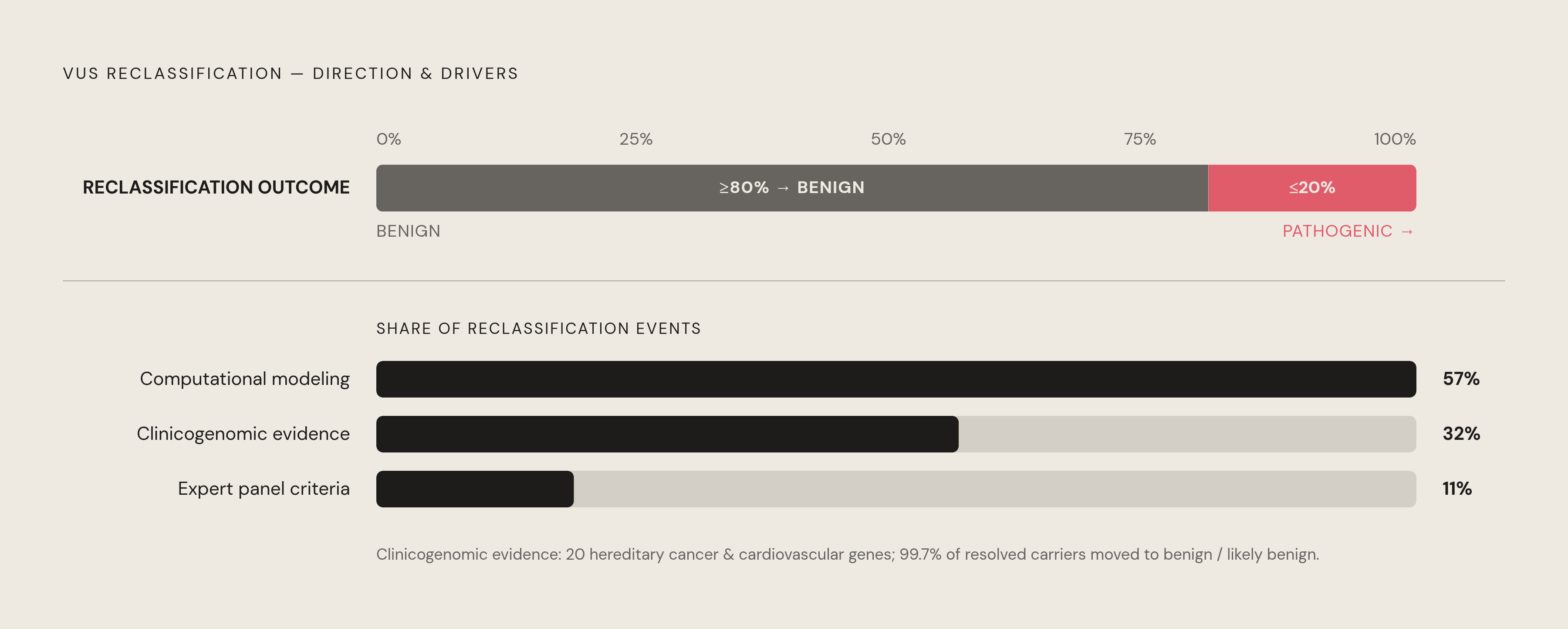
Direction matters as much as frequency here. At least 80% of reclassified VUS move toward benign, which means the single most likely outcome of any given VUS getting reclassified is reassurance, a gentler resolution than the diagnosis patients often brace themselves for.
What pushes a variant across that line? Computational modeling accounts for the largest share of movement, roughly 57% of reclassification events, reflecting better algorithms for predicting how a variant affects protein function. Real-world evidence pulled from large clinicogenomic datasets, patient outcomes tracked at scale, has been applied across 20 hereditary cancer and cardiovascular genes and provided enough evidence to reclassify 32% of VUS carriers in that group; of those, 99.7% moved to benign or likely benign, and only 0.3% moved toward pathogenic. Gene-specific expert panels add another layer: gene-specific expert panel criteria have similarly demonstrated the ability to resolve a meaningful share of previously unclassified variants.
The upshot is not a small one: a VUS reported today carries a real shelf life, and it's more likely to resolve toward good news than one reported a decade ago ever was, back when the databases were thinner and the algorithms cruder.
What clinicians and patients can do in practice to manage a VUS finding over time
Reframe the whole thing as a snapshot rather than a verdict. A VUS captures what the evidence says at the moment of testing; it isn't a permanent label stapled to the variant for life. The job from there is management over time, not demanding a resolution the evidence can't deliver yet, and pretending otherwise just sets everyone up for a worse conversation later on.
For clinicians handling the report: don't shift management based on the VUS alone, since the evidence bar for action hasn't been cleared. When a patient carries both a VUS and a pathogenic variant, say explicitly which result is actually driving the plan; don't let the ambiguous one crowd out the one that matters. Document the VUS somewhere easy to find later, because reclassification only helps if someone notices it happened months or years down the line. For patients from underrepresented ancestry groups, say the quiet part out loud: the VUS in front of them may reflect a gap in the database, not genuine biological ambiguity.
Ongoing monitoring carries as much weight as the initial conversation, arguably more. Clinicians should have a clear plan for how reclassification updates make it back into the patient's chart instead of going unnoticed. New family history can shift the evidence balance even before a lab issues a formal update, so periodic re-review earns its time. Family testing, gathering co-segregation data by testing relatives, remains one of the more workable paths toward new evidence, and it's something clinicians can push forward actively instead of waiting around for a lab to move first.
On the patient side, set expectations early: a VUS calls for monitoring as part of the plan, a genuinely useful signal rather than a consolation prize handed out because the test didn't work properly. Consistent messaging across every provider touching the case cuts down the between-provider discordance that drives most of the distress described earlier. It's worth repeating plainly that the most probable outcome of eventual reclassification, for the majority of VUS, is benign. That's what the reclassification data actually shows.
One more piece, easy to skip past: contributing variant and phenotype data back to shared databases like ClinVar, or to gene-specific registries, speeds up reclassification for everyone downstream. Every patient's data point becomes a small contribution toward someone else's future answer, which is a fairly direct illustration of how information sharing at scale pays off for the one person sitting across from a genetic counselor asking, reasonably, "so what does this actually mean for me?"