Natural Language Processing for Unstructured EHR Data in Preventive Screening
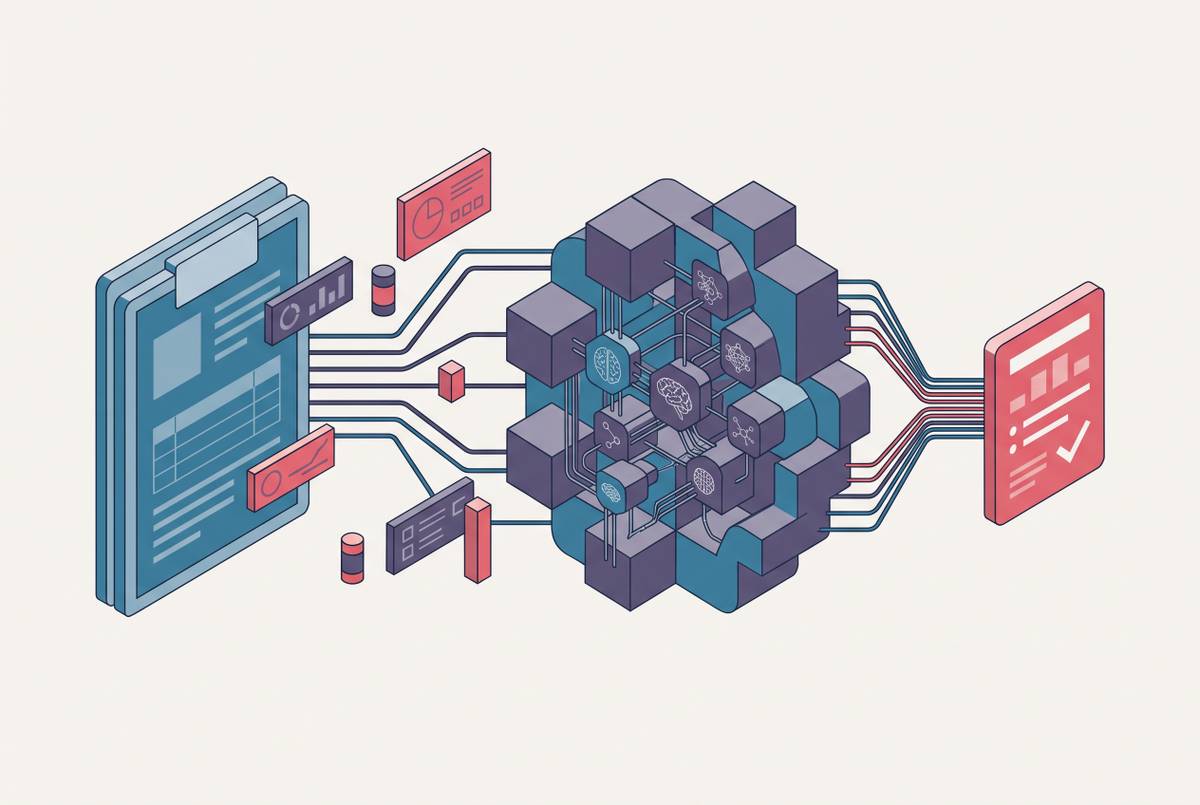
NLP extracts screening gaps from clinical notes that structured data alone cannot find.
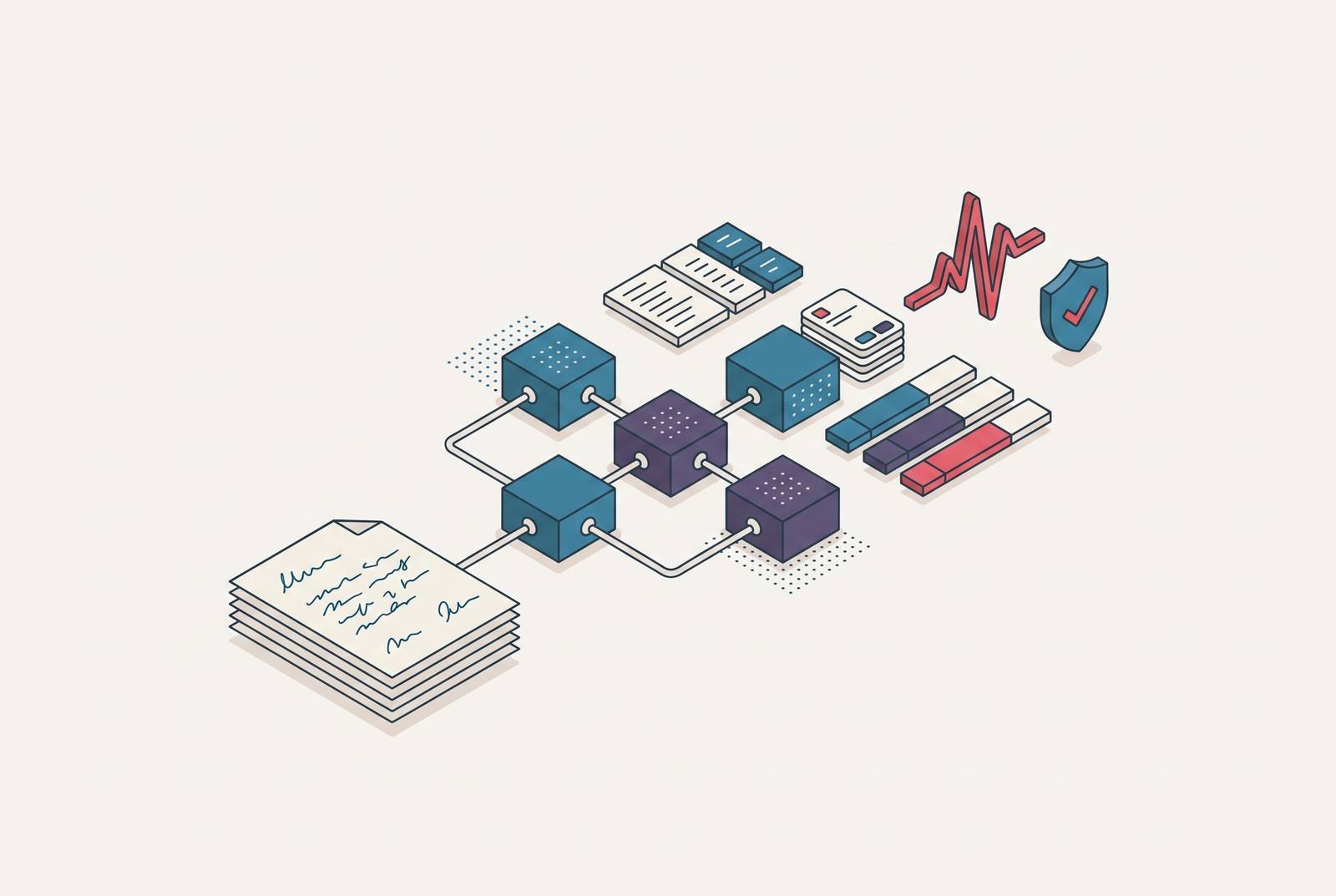
Clinical notes run on abbreviations, shorthand, half-finished thoughts, and negation that flips meaning. "No family history of CRC" and "family history of CRC" differ by two words and mean opposite things to a screening algorithm. Hedging language like "patient denies" or "reports possible" produces a document a human clinician reads without a second thought, but a keyword search chews up and misreads.
Then there's the variation across providers. A cardiologist in one clinic abbreviates a term the same specialist three floors down spells out in full, while a third documents it as a discrete code because that's how their template happened to get built. Every specialty, every EHR vendor, and every institution multiplies this variation, so the resulting corpus has no single grammar to lean on. Anyone who treats clinical text as one consistent dialect is setting a model up to fail on day one.
Negation and assertion status carry particular weight in screening contexts. "Patient has not had a colonoscopy," "colonoscopy refused," and "colonoscopy scheduled" describe three different clinical situations, yet structured fields tend to collapse them into a single checkbox or leave them blank. A note might reference a test from three years ago, a recommendation for next year, and a conditional follow-up dependent on symptoms, all in the same paragraph. Pulling out when something happened, versus when it's due, versus when it might happen, takes more than matching a string of characters. It takes reasoning about time that most structured systems were never built to do, and that gap is the whole reason this problem hasn't been solved by better spreadsheets.
The NLP technique stack: from rule-based extraction to large language models
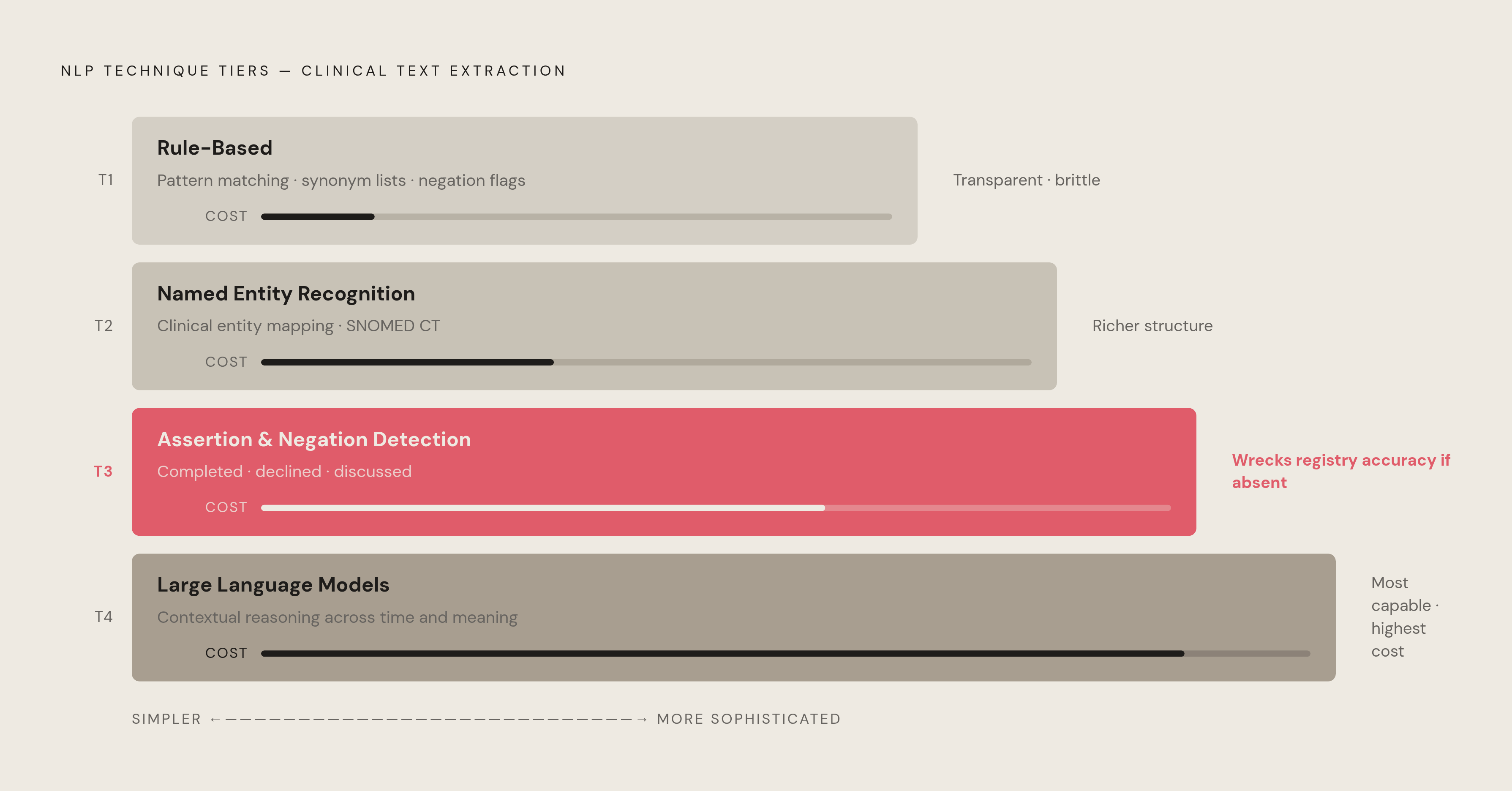
NLP is a real range of approaches, and picking the wrong tier for a given job either means the system misses everything subtle in the note, or it costs more to build and maintain than the gap it closes. It's a real range of approaches, and picking the wrong tier for a given job either means the system misses everything subtle in the note, or it costs more to build and maintain than the gap it closes justifies. That tradeoff decision, tier against task, deserves more scrutiny than most teams give it.
Rule-based systems are at the simpler end: explicit pattern matching built from inclusion and exclusion criteria, synonym lists, acronym tables, and negation flags. A clinician can trace why the system flagged something, and there's no model training overhead to manage. The tradeoff is brittleness. Shift the documentation style even slightly and the rules stop matching. Veradigm's 2025 work extracting lipid markers from clinical notes used a rules-based algorithm, a choice that reflects the practical advantages of transparency when establishing a new extraction pipeline.
Named entity recognition, or NER, goes further. It identifies and classifies clinical entities inside free text, things like symptoms, diagnoses, medications, and test results, then maps them to standardized ontologies like SNOMED CT. That mapping is what lets a "colonoscopy" mentioned by one provider and a "colonoscopy" mentioned by another land in the same structured field, instead of sitting as two unrelated strings of text with no relationship to each other.
Assertion detection and negation handling sit on top of NER, and this is where most of the real screening value actually lives. Spotting the word "colonoscopy" in a note isn't enough on its own. The system has to identify whether the colonoscopy was completed, declined, or merely discussed as an option, and getting that distinction wrong is what causes a patient who refused screening to get counted as compliant, or a patient who's overdue to get skipped. Assertion status, more than any other single failure mode on this list, is what wrecks registry accuracy.
Screening gaps that structured data alone cannot find
Once free text gets converted into structured, queryable signals, those signals can feed population health dashboards, care gap registries, and outreach workflows that were previously running on incomplete information. The logic holds steady across use cases. What changes is how it plays out for each screening type.
Family history extraction is the clearest case. A provider note might mention a first-degree relative diagnosed with colorectal cancer before age 45, a detail that raises that patient's own screening urgency substantially. If the structured record carries no corresponding flag, that patient stays invisible to any registry built on structured fields alone, no matter how carefully the registry was designed. NLP pulls that mention out, flags the patient, and triggers portal outreach recommending earlier or more frequent screening. It's a risk signal that almost never earns its own checkbox.
Colonoscopy follow-up tracking works the same way. A patient who had polyps removed needs a shorter interval before the next screening, and if that recommendation lives only in a pathology note nobody re-reads, it disappears. When post-polypectomy follow-up recommendations live only in notes that are rarely revisited, those recommendations can be lost before they translate into action. A prospective pre-post study deployed an automated rules engine in May 2023 that used colonoscopy pathology results to update CRC screening due dates across an entire health system, enterprise-wide. Closing a documentation gap chart by chart and closing it at scale are two different problems, and most pilots only prove the first one.
Cardiovascular screening shows the same pattern outside the cancer context. Veradigm's analysis, drawing on a dataset covering more than 152 million patients with over a decade of clinical activity, found that roughly 20% of adults had discordant apoB and LDL-C values, a mismatch standard lipid panels don't catch on their own. Combined structured and NLP-enhanced analysis showed a meaningful share of the at-risk adult population going unidentified under the current standard of care. That's one in five patients a lipid panel alone would have cleared, a meaningful share rather than a rounding error. That's one in five patients a lipid panel alone would have cleared.
Evidence on NLP-assisted colorectal cancer screening: what recent studies show
CRC screening is one of the better-studied domains for this kind of work, mostly because colonoscopy generates both a structured result (positive, negative, polyp count) and a dense block of free text describing findings, recommendations, and follow-up reasoning. That pairing makes it a useful test case for what NLP adds on top of the structured record, and the evidence here is more concrete than in most other screening domains.
Researchers have applied NLP specifically to pull colonoscopy-related detail out of EHR notes: whether a test was mentioned, when it happened, its scheduling status ("refused," "scheduled," "completed"), and whether a negation modifier changes the meaning. A structured field built around a handful of dropdown options cannot capture that kind of nuance. Treating it as though it can is where a lot of registries quietly go wrong, and it's the single most common design mistake in this space.
ColAI, a model built on L1-regularized logistic regression, was trained on 87,825 screening colonoscopies and validated against 21,957 independent procedures from the NYU Langone Health system. It reached an AUROC of 0.93 for detecting CRC and 0.98 for CRC or advanced adenoma, and its performance across the validation set demonstrated strong generalizability on held-out procedures. That stability matters because generalizability tends to collapse when a model moves from one health system to another. ColAI leans on routine EHR data rather than pure free-text extraction, but it still shows what becomes possible once EHR data gets mined comprehensively instead of selectively.
A 2026 study run under RTI International and the National Cancer Institute's ACCSIS program looked at how EHRs and health IT tools get used to track patients and manage colorectal screening interventions across primary care practices. The researchers examined how EHR data capture and health IT tools supported these workflows, surfacing practical challenges in translating system capabilities into consistent clinical action. Better tooling helps, but it doesn't remove the need for the people running the workflow to understand what the system is doing and why. That's the part a pilot that looks good on paper tends to skip over.
Policy pressure making NLP-assisted screening identification more urgent
Starting December 30, 2025, group health plans and insurers have to fully cover additional breast cancer imaging and testing, along with patient navigation services for breast and cervical cancer screenings, with no cost sharing. That's a compliance requirement with teeth, not a minor administrative update, and it changes what health systems now have to prove.
Health systems and payers need to know exactly which patients qualify for these newly mandated screenings, and they need to show that gaps are actually closing, not just that a policy exists somewhere on paper. Structured data alone won't get them there. Eligibility for expanded breast cancer imaging often hinges on risk factors that appear only in provider notes, such as dense breast tissue, a prior abnormal finding, or a family history mentioned in passing during an unrelated visit. These are exactly the signals NLP is built to surface, and they are exactly the signals a structured-fields-only approach was never designed to catch.
Patient navigation services are now a covered benefit under this mandate, but a navigation program is only as good as the list of patients it's working from. An NLP-derived gap list, built by extracting risk factors and screening history out of free text rather than relying on whatever happened to get checked in a structured field, is what makes that navigation benefit operational instead of aspirational.
Where NLP-assisted screening programs run into practical friction
Privacy sits at the top of the list, and for good reason. Clinical notes hold some of the most sensitive information a health system has, and any NLP pipeline touching that text needs de-identification, access controls, and audit trails built in from the start, not bolted on after the fact. Training models on anonymized datasets and layering in strong encryption helps, but neither comes free. Both add real complexity to deployment and slow down how fast a system moves from pilot to production.
Public clinical datasets are scarce, so most NLP models end up trained on proprietary, institution-specific text instead. That limits both generalizability and reproducibility, and it should be treated as the default risk rather than an edge case. A model tuned on one hospital system's documentation habits can simply fail to transfer when it meets a different institution's shorthand, templates, and specialty mix. That failure mode occurs often enough that teams should plan for it from the start, not react to it after deployment.
Annotation bias and data heterogeneity compound the problem. Documentation style varies enough from provider to provider, and institution to institution, that a model trained on one population can underperform badly on another. Systematic reviews of NLP in healthcare name this directly as one of the field's unresolved challenges, not a problem quietly being ironed out at the margins.
Interoperability is the last major snag, and arguably the most stubborn of the four. Plenty of healthcare IT environments remain siloed, and an NLP tool built for one EHR platform doesn't automatically work across a health system running two or three different ones at once. Interoperability standards keep improving, but the underlying problem stays unsolved, and treating it as solved does a disservice to the teams actually stitching these systems together.
What a well-designed NLP pipeline for preventive screening looks like end to end
Start by clarifying what clinicians actually need to know, before any data science happens. Someone has to define what entities matter, what temporal context is relevant, and which negation patterns change the meaning of a given screening type. Skipping this step means the extraction work downstream ends up accurate at matching text while still unable to answer whether the patient was actually screened. Veradigm's 2025 workflow began exactly this way: a clinician-developed workbook laying out inclusion and exclusion criteria, built before a single line of extraction code ran.
From there comes the extraction itself, either rules-based or model-based, pulling relevant mentions out of provider notes and mapping them to standardized ontologies like SNOMED CT. Skipping that mapping step makes cross-system comparison impossible. Every institution's extracted data stays locked inside its own vocabulary, unreadable to anyone outside that system.
Iterative clinician validation follows, and skipping it is how pipelines quietly drift into unreliability. Someone with clinical judgment has to review samples of what the system pulled out, flag errors, refine the criteria, and repeat the cycle until accuracy clears a threshold usable in real practice, in production and not just in a demo. Veradigm iterated until its outputs exceeded 93% accuracy, then kept refining from there until it reached 97%.
The last step is enrichment: converting NLP outputs into structured, queryable fields that sit alongside existing registry data. This step is what actually closes the loop. A signal buried in a free-text note from two years ago appears on a population health dashboard today, sitting next to the lab values and diagnosis codes it was never able to join before.
Sources
- Neural Natural Language Processing for unstructured data in electronic health records: A review - ScienceDirect
- Innovative EHR Evidence Generation Using NLP and LLMs | Veradigm
- Natural Language Processing in Electronic Health Records in relation to healthcare decision-making: A systematic review - ScienceDirect
- pubmed.ncbi.nlm.nih.gov