Lipoprotein(a) Testing in Cardiovascular Preventive Panels
A cheap genetic test catches the one-in-five adults at hidden heart risk.

Roughly one in five adults worldwide carries a genetically elevated Lp(a) level that substantially raises heart attack and stroke risk, independent of cholesterol, and most of them will never find out. The test that would tell them costs less than a dinner out and only needs to run once in a lifetime. The gap between what medicine knows about Lp(a) and what medicine actually does with that knowledge is the subject of this piece, and the gap is the fault of the system, not the science.
Lipoprotein(a) was first described in 1963 by the Norwegian geneticist Kåre Berg, who identified it as an LDL-like particle distinguished by a second protein, apolipoprotein(a), bound to apolipoprotein B100. What sets it apart from every other number on a lipid panel isn't its structure so much as its behavior: levels are set almost entirely by genetics, highly heritable, and they stay flat across a person's lifetime. Diet doesn't move it. Exercise doesn't move it. Most drugs built to lower LDL cholesterol don't touch it either. That looks like a limitation, but it's actually the opposite: a marker that never changes only needs to be measured once, non-fasting, at any point in adulthood, to tell a clinician something true for the next fifty years.
The mechanism behind the risk is mapped reasonably well by now. Elevated Lp(a) drives plaque formation, promotes clotting, and triggers inflammatory pathways, three separate routes to vascular damage that all run independently of LDL cholesterol. The associations reach past coronary artery disease into aortic valve stenosis, ischemic stroke, peripheral arterial disease, and heart failure, though coronary disease and aortic stenosis remain the strongest and most consistent links. Mendelian randomization studies, which use genetic variants as a kind of natural experiment to separate correlation from causation, confirm this isn't an association riding alongside some other risk factor. Lp(a) causes elevated risk for coronary heart disease, large-artery stroke, peripheral artery disease, and aortic stenosis on its own.
How large the Lp(a)-affected population actually is
Clinically meaningful elevation affects an estimated 20 to 25 percent of people globally, which works out to as many as 1.5 billion people carrying this risk factor right now. Somewhere between 10 and 30 percent of the world's population is above 50 mg/dL, the threshold most commonly tied to meaningful cardiovascular risk. These numbers put Lp(a) elevation in the same population-scale category as hypertension or elevated LDL cholesterol, and treating it as a niche concern misreads the scale of the problem.
Prevalence isn't evenly distributed across ancestry groups, and that unevenness deserves more attention than it usually gets. A large UK study covering more than 460,000 middle-aged participants found median Lp(a) levels of 19 nmol/L in White individuals, 31 nmol/L in South Asian individuals, and 75 nmol/L in Black individuals, a nearly fourfold spread across the median alone. Among people in that same study who already had established atherosclerotic cardiovascular disease, 20 percent had Lp(a) above 150 nmol/L, compared with 12 percent of those without disease.
Applying one flat threshold to every patient regardless of ancestry will systematically undercount risk in populations whose baseline levels run higher to begin with. That is a detail worth more than a passing mention. It's a design flaw baked into how the threshold gets used in clinics right now, and it means the same cutoff that correctly flags risk in one population quietly misses it in another.
How rarely Lp(a) is actually tested, and what explains the gap
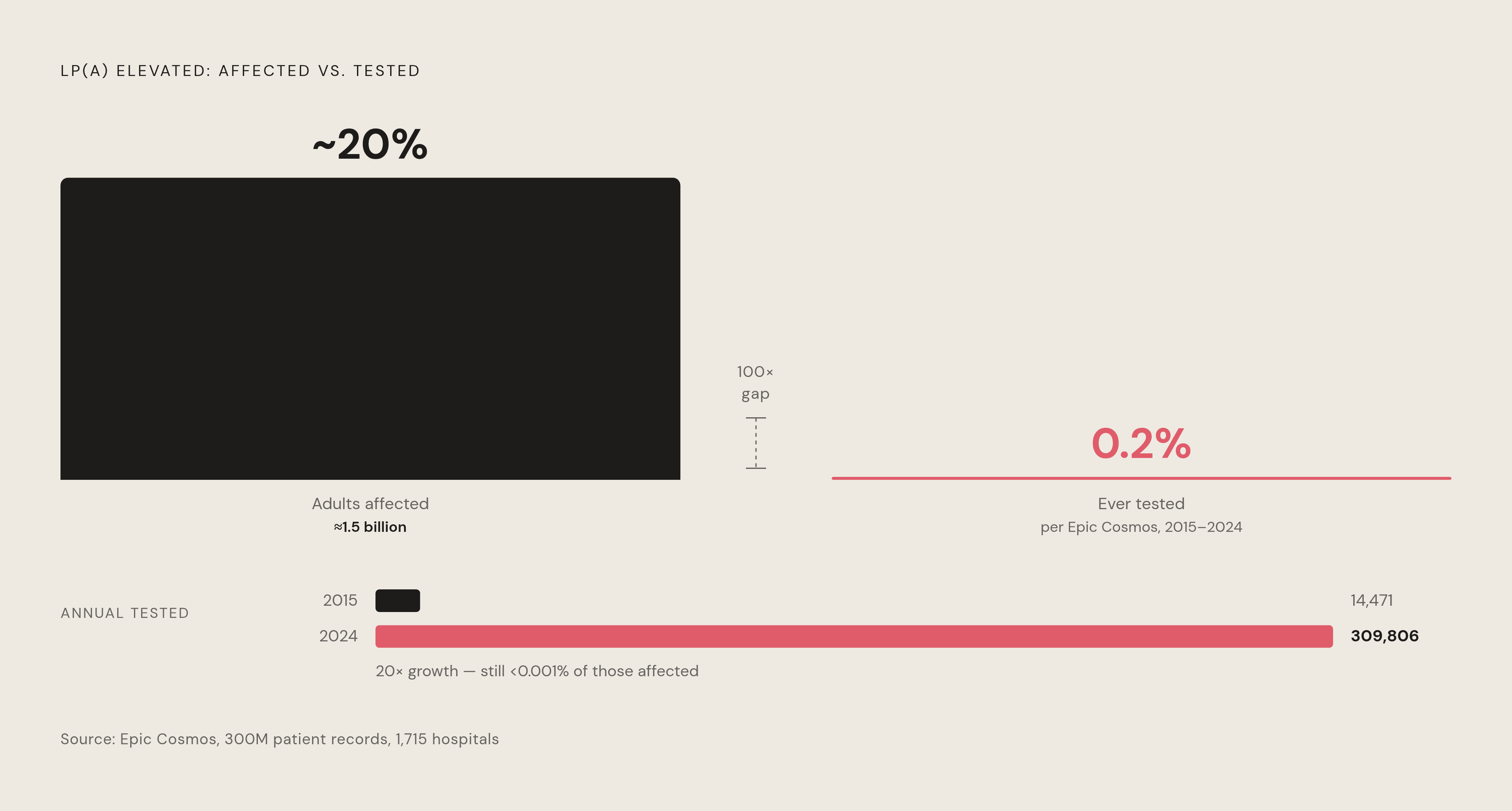
A risk factor affecting roughly one in five people ought to sit near the top of a standard workup. Instead, screening rates have historically stayed below 1 percent of adults, a mismatch large enough to call structural rather than incidental.
Data from Epic Cosmos, drawn from more than 300 million patient records across more than 1,715 hospitals and 41,000 clinics, shows that from 2015 through 2024, only 0.2 percent of the population had ever been tested for Lp(a) at all. The trend is moving, just slowly: annual tested patients climbed from 14,471 in 2015 to 309,806 in 2024. That's more than a twentyfold increase in relative terms, and still a rounding error against the size of the affected population.
Health system data backs up the national picture. At Northwell Health, among outpatients who had at least one lipid panel ordered between 2022 and 2024, only 3.7 percent also got an Lp(a) test alongside it, despite the two tests can be ordered on the same visit. That last detail matters: the friction is the wait for results, not the blood draw. It's everything upstream of it.
Three barriers explain most of the gap, and one of them does the most damage. Reimbursement is the biggest problem: Medicare coverage policy still traces back to a 2009 USPSTF report written before the large genetic and epidemiological studies that established Lp(a) as the strongest known inherited cardiovascular risk factor, and CMS has issued no national coverage guidance, leaving individual plans and contractors to decide on their own. Provider knowledge gaps compound it, since plenty of clinicians trained before this evidence base existed and don't know how to explain a genetic risk marker to the patient sitting across from them. And a circular logic problem runs underneath both: without an approved drug that specifically lowers Lp(a), some clinicians reason there's nothing to do with an elevated result, so why order it.
That last piece of reasoning is wrong. An elevated Lp(a) result already changes how aggressively a clinician manages LDL cholesterol, a lever that's been in the toolkit for decades. Treating "nothing to do" as the default understates what the test offers, and it's the single most correctable error in this entire chain.
How guidelines shifted from selective to universal screening between 2018 and 2026
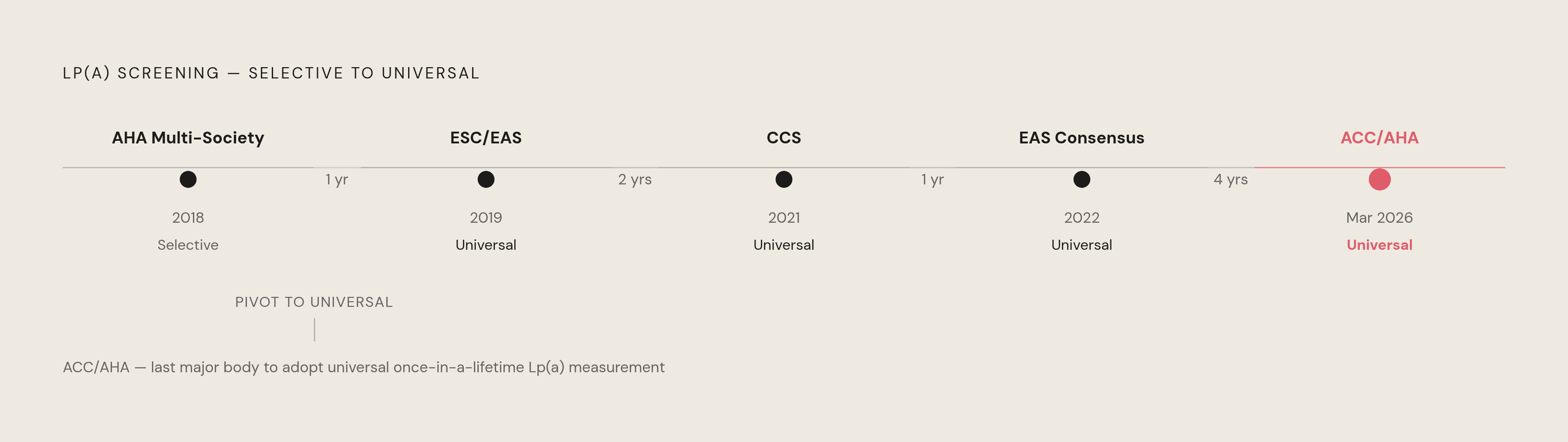
The 2018 AHA Multi-Society Cholesterol Guidelines suggested Lp(a) screening only for people with a family history of premature atherosclerotic disease or an unexplained personal history. That was a narrow, selective ask by design, and it left most of the at-risk population untouched.
Europe moved first. The 2019 ESC/EAS dyslipidaemia guidelines and the 2022 European Atherosclerosis Society consensus both recommended measuring Lp(a) at least once in every adult, specifically to catch the high cardiovascular risk a standard lipid panel would otherwise miss. The 2021 Canadian Cardiovascular Society guidelines landed in the same place.
Then, on March 13, 2026, the ACC/AHA released its updated Multisociety Guideline on the Management of Dyslipidemia, and even the title change signals the shift: the 2018 document was called the "Guideline on Management of Blood Cholesterol." Retitling it to cover "Dyslipidemias," plural, reflects a broadened scope that now folds in Lp(a) alongside LDL. For the first time, the ACC/AHA recommends measuring Lp(a) at least once in every adult's lifetime as part of standard cardiovascular risk assessment, alongside selective Lp(a) screening in children with relevant family history and a push toward more aggressive LDL-C targets overall. When Lp(a) comes back high, the guideline states that clinicians should manage every other modifiable risk factor, especially LDL-C, more intensively and earlier than they otherwise would.
Eight years, several major guideline bodies, one consistent direction. Family-history-only screening gave way to universal screening not because of a single landmark trial but because Mendelian randomization data and large cohort studies kept pointing the same way, year after year, until the evidence grew too broad to keep treating Lp(a) as a niche marker.
What the risk thresholds mean in practice and how to read a result
The 2026 ACC/AHA guideline lays out a graded structure rather than a single cutoff. Around 125 nmol/L, or roughly 50 mg/dL, risk becomes clinically meaningful. Above that level, progressively higher values are associated with a substantially higher-risk phenotype. These aren't new inventions: the 50 mg/dL threshold traces back to early EAS guidance, and more recent guidance acknowledges a grey zone of intermediate values that reflects a relationship with risk that's continuous and linear rather than a hard on/off switch.
The two-to-threefold rise in myocardial infarction risk tied to elevated Lp(a) sits in the same range clinicians already associate with familial hypercholesterolemia, a genetic condition most physicians already treat aggressively on sight. That comparison matters, because it hands clinicians a mental model they already trust for a marker they may not.
What a result does not do matters as much as what it does. Because levels are fixed by genetics early in life, a normal result offers reassurance that holds for decades, and there's little reason to repeat the test in someone who comes back low. An elevated result, meanwhile, is a signal without a matching drug, since no broadly approved therapy that targets Lp(a) specifically is yet in routine clinical use. What it is, instead, is an instruction to treat everything else more seriously, starting with LDL-C. Evidence supports that lowering LDL-C mitigates some of the recurrent-event risk in patients who already have established cardiovascular disease and high Lp(a). That's the practical mechanism behind the guideline's advice: treat the elevation as a reason to push LDL-C lower, not as a dead end.
Why measurement methodology and lab standardization still cause problems
Lp(a) resists simple, accurate measurement. Its apolipoprotein(a) component varies in size from person to person, a property called isoform polymorphism, and that variability distorts mass-based assays unless the lab uses methods built specifically to ignore isoform size.
HEART UK issued consensus recommendations in 2019 addressing exactly this problem: use antibody-based methods that minimize the isoform size effect, calibrate against WHO/IFCC reference material, and report results in nmol/L rather than mg/dL, since converting between the two units introduces inaccuracy the field has been trying to phase out. Assays calibrated to the WHO/IFCC standard and reported in nmol/L represent the preferred approach.
Adoption has lagged badly behind the recommendation, and this is where the guideline momentum runs into a wall nobody's fixed yet. A 2021 survey of UK clinical laboratories found that only 5 percent had fully implemented the HEART UK guidance, and most labs surveyed weren't even sure which Lp(a) method they were running. That's a striking admission from the institutions responsible for generating the number a clinician relies on. The practical consequence: a physician who orders the test in good faith can get back a result that doesn't line up cleanly with the thresholds cited in the major guidelines, particularly if the lab reports in mg/dL and the number reflects a converted value rather than a direct molar measurement. Universal screening only delivers on its promise if lab infrastructure catches up at the same pace as the guideline language. Right now, it hasn't, and no amount of guideline language fixes a miscalibrated assay.
What it costs to get tested and where insurance coverage currently stands
Out-of-pocket, the test runs somewhere between $39 and $177 at commercial laboratories, according to figures the American Academy of Family Physicians published in February 2024. It's widely available without a specialty referral, which removes one common barrier to preventive testing right out of the gate.
Insurance is a different story, and a worse one. Medicare doesn't currently cover Lp(a) testing for cardiovascular risk assessment, a policy still anchored to that 2009 USPSTF report predating the genetic and epidemiological evidence now underlying the 2026 ACC/AHA guideline. CMS has never issued a dedicated national coverage policy for Lp(a), and existing regional coverage policies, including one identified as L36358, actively deny coverage for it as a cardiovascular biomarker. Medicare coverage ends up varying by plan and by contractor, which produces uneven access across a population that skews older, and, not incidentally, skews toward the age range where cardiovascular risk stratification matters most.
National guidelines now call for universal, once-in-a-lifetime testing. National insurance policy hasn't moved to match it, and the result is that cost and coverage differ by plan and setting in ways invisible to most patients sitting across from their doctor. The relatively low cash floor of $39 means price alone won't stop everyone. But for patients on fixed incomes or in underserved communities, the absence of routine coverage widens a gap that testing disparities have already carved out.
What clinicians can do now, before targeted therapies arrive at scale
The most common objection to ordering the test, that without an approved Lp(a)-lowering drug there's nothing to act on, misreads what the result is for. That objection should stop being repeated in clinic hallways, because it's been wrong since at least the 2019 European guidance.
An elevated Lp(a) reading opens several doors immediately. It justifies more aggressive LDL-C targets, since the 2026 ACC/AHA guidance treats high Lp(a) as a reason to manage every other modifiable risk factor harder. It can tip a borderline-risk patient toward earlier statin initiation, or toward a PCSK9 inhibitor, in someone who might otherwise just get watched and rechecked in a year. Because the risk is inherited, one patient's result also flags first-degree relatives for cascade testing, stretching the value of a single blood draw across an entire family. Lifestyle interventions, blood pressure control, smoking cessation, weight management, all take on added urgency once Lp(a) elevation is on the chart.
The investigational pipeline isn't standing still either. The 2025 American Society for Preventive Cardiology flagged Lp(a) and its inflammatory pathway as a causal risk factor and discussed the field's readiness for targeted therapies, which suggests the current "nothing to prescribe" window won't last. But what makes the test worth ordering today has nothing to do with waiting for that pipeline to mature. Unlike almost every other cardiovascular biomarker in routine use, Lp(a) asks for one non-fasting blood draw, ordered once, to deliver a signal that holds for a lifetime. The barrier to acting on that signal is about as low as preventive medicine gets, and the 2026 ACC/AHA guideline now gives primary care clinicians the formal footing to add it to a standard lipid panel without waiting for anything else to change first.
Sources
- 2024: The year in cardiovascular disease – the year of lipoprotein(a). Research advances and new findings - PMC
- New United States Dyslipidemia Guideline Updated to Improve LDL-C Management and Lipoprotein(a) Detection - Family Heart Foundation
- Evolving strategies in cardiovascular disease prevention: 2025 American society for preventive cardiology highlights - ScienceDirect
- Lipoprotein(a) and cardiovascular disease: sifting the evidence to guide future research | European Journal of Preventive Cardiology | Oxford Academic
- Lipoprotein(a) Testing Trends in the United States 2015-2024: An Analysis of 300 Million Individuals