Omega-3 Index Testing in Cardiovascular Risk Assessment
Blood tests reveal most Americans lack omega-3 levels needed to prevent heart disease.

The Omega-3 Index has quietly graduated from a nutrition-world talking point into something closer to a formal risk factor for heart disease, on par with cholesterol and smoking status in some head-to-head comparisons. It measures the combined amount of EPA and DHA in red blood cell membranes, expressed as a percentage of total fatty acids, and it now has data behind it precise enough to change how cardiovascular risk gets calculated.
The index is not a proxy for what someone ate last night. Because red blood cells live for roughly 120 days, the fatty acid composition of their membranes reflects an average of omega-3 intake and incorporation over the prior three to four months. That makes the O3I function much like hemoglobin A1c does for glucose control: not a snapshot, but a rolling average that smooths out the noise of any single meal or missed fish-oil capsule. Earlier omega-3 research leaned heavily on food frequency questionnaires, which ask people to recall how often they ate salmon or took a supplement over the past year. The O3I sidesteps memory and self-report entirely and measures what actually made it into tissue, which turns out to correlate far better with cardioprotective outcomes than recall data ever did.
Harris and von Schacky first proposed the index in 2004, arguing it functioned as a risk factor for death from coronary heart disease, and the field did not formally evaluate whether it met the criteria to earn that label until 2009, five years later. Because a biomarker just reflects something happening in the body, a risk marker carries some health implication, and a risk factor has to be causally plausible, independently predictive, and modifiable, treating the O3I as a risk factor rather than a mere correlate changes what claims can legitimately be made about it. A biomarker just reflects something happening in the body. A risk marker carries some health implication. A risk factor has to be causally plausible, independently predictive, and modifiable, and the O3I was built, from the start, to make a case for the third and hardest category.
EPA and DHA are not interchangeable, despite getting lumped together constantly. DHA concentrates in brain and retinal membranes and helps maintain membrane fluidity there. EPA barely accumulates in brain tissue at all and instead does most of its work in systemic inflammatory pathways. Research summarized by Today's Dietitian shows both serve as precursors to specialized pro-resolving mediators, the molecules responsible for actively shutting down inflammation rather than just blocking it. That distinction becomes important later, when the supplementation trials start pulling in different directions depending on which fatty acid dominates the dose.
The three-tier risk scale and what each threshold predicts
Start with the number that should stop most readers cold: a tenfold difference in sudden cardiac death risk between people at the low end of the Omega-3 Index and people at the high end. That figure has shown up across independent cohort studies using different populations and sample types, a degree of replication that is rare in nutritional epidemiology and is the reason the O3I gets taken seriously by people who are otherwise skeptical of dietary biomarkers.
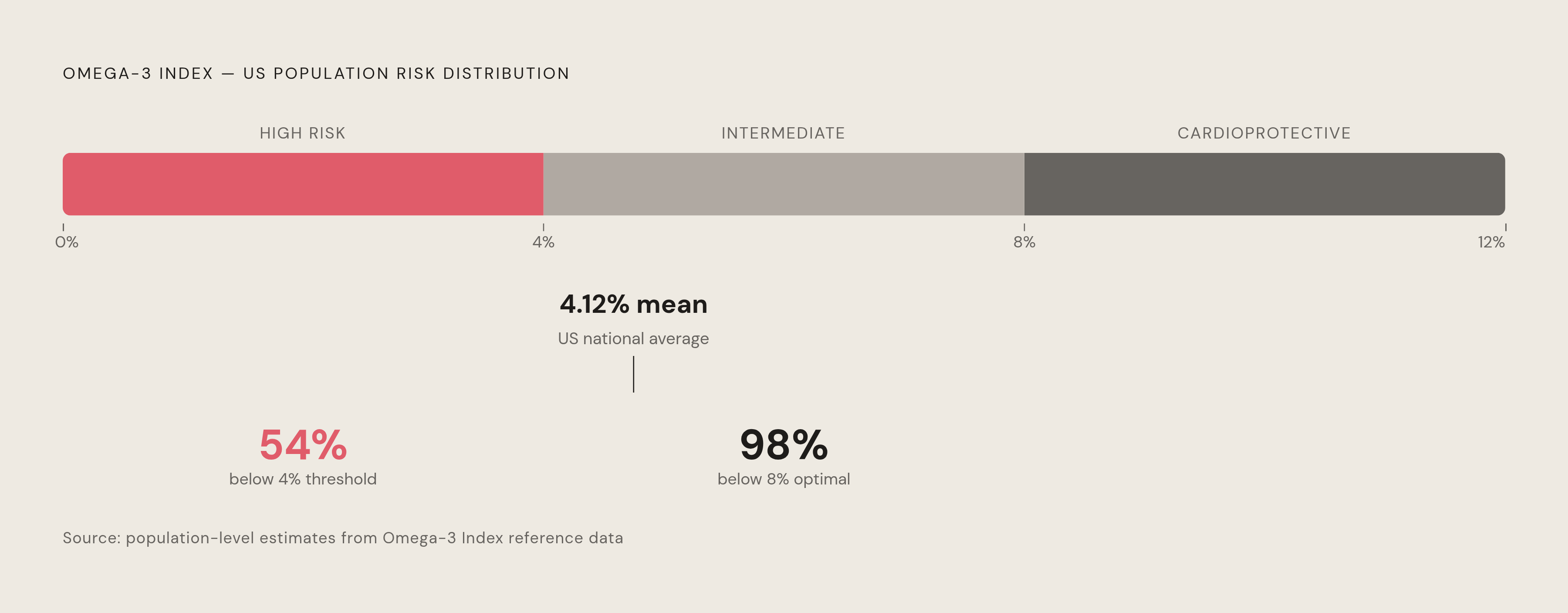
The scale itself breaks into three bands. Below 4% counts as high risk, and it's the range associated with the sharpest jump in cardiovascular events and sudden death. Between 4% and 8% is an intermediate zone, better than nothing but far from protective. Above 8% is where the literature starts using the word cardioprotective, with the functional medicine and cardiovascular research literature pointing to 8% and above as the optimal window.
Japan offers the cleanest natural experiment. Mean O3I there runs above 8%, and the country has one of the lowest sudden cardiac death rates in the world alongside a life expectancy that exceeds that of countries where the mean O3I sits closer to 4%. Correlation is not causation, and diet differs from Japan to the US in dozens of ways beyond fish consumption. The gap lines up with the biomarker in a way that's hard to wave off as coincidence, especially given how consistently separate reviews tie the higher end of the index to lower total mortality and fewer major adverse cardiac events, alongside knock-on benefits for brain function.
Where most Americans fall on that scale
The first nationally representative answer to that question arrived in a 2026 study published in Current Developments in Nutrition, drawing on NHANES data collected between August 2021 and August 2023. Researchers analyzed blood samples from more than 7,200 Americans, age six and up, and it's the first time the Omega-3 Index has been measured at that kind of national scale in the US.
The topline number is not encouraging. Fifty-four percent of Americans landed below 4%, the threshold classified as high risk. Nearly 98% fell short of the 8% optimal target. The national mean came in at 4.12%, which puts the average American just barely above the high-risk cutoff and nowhere close to cardioprotective territory.
Within the adult subsample, a substantial group aged 20 and older, the index ran higher among females, non-Hispanic Asians, people above the poverty line, and people with education beyond high school. That pattern tracks the same fault lines that appear across most other health equity measures in the US, which suggests omega-3 status is not just a matter of personal food preference but something shaped by income, access, and education the same way blood pressure control or diabetes management are.
One curious wrinkle: the index rose with age across the full sample. Cardiovascular risk also climbs with age, and the two moving in the same direction raises questions the NHANES data cannot answer on its own, since it captures prevalence at a single point in time rather than tracking outcomes. Cross-national research has found the same story playing out globally, with most nations clustering in that same low range. The US is the norm here. It's the norm.
The NHANES numbers cannot show whether the Americans sitting below 4% actually go on to have more heart attacks, more strokes, more sudden cardiac events. That's a prevalence study, not an outcomes study. The next body of research fills that gap.
How the O3I performed against the standard 10-year cardiovascular risk calculator
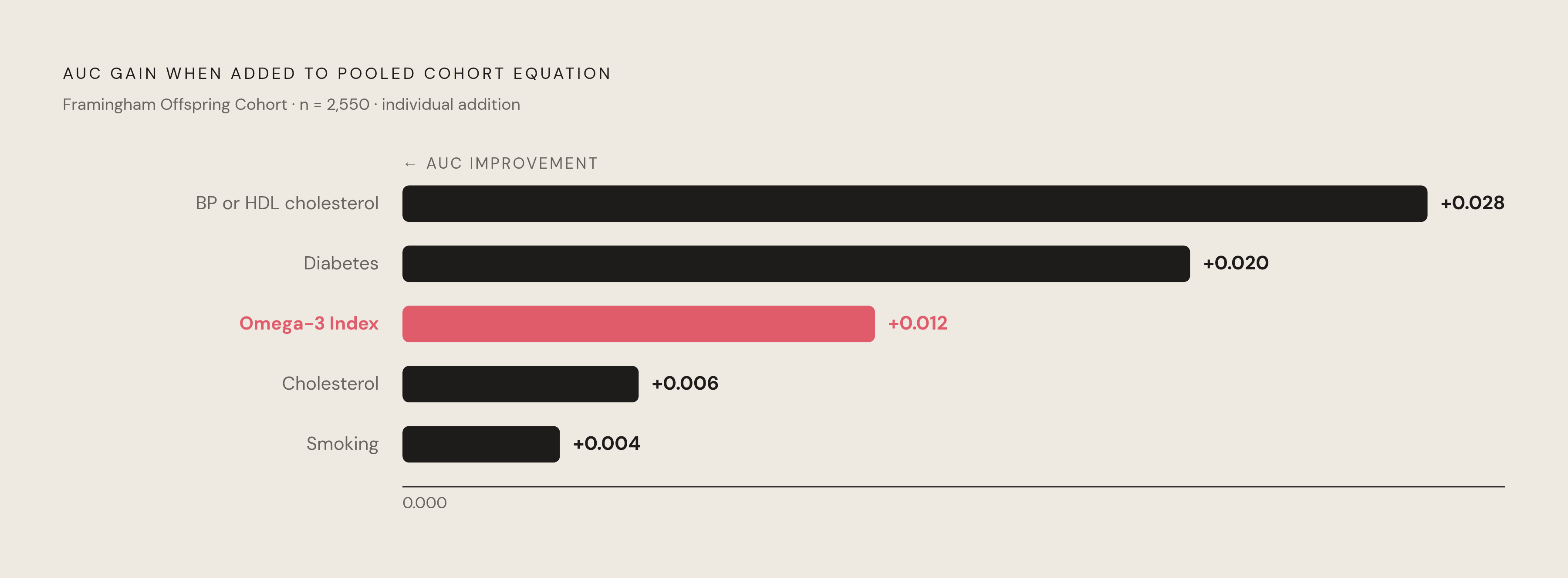
The test that matters most for clinical relevance came from the Journal of Clinical Lipidology, published online in February 2025 and formally in print the following month. William G. Franco led the study, with William S. Harris, founder and president of the Fatty Acid Research Institute, as a co-author. The design pulled 2,550 participants from the Framingham Offspring Cohort, all free of atherosclerotic cardiovascular disease at baseline, average age 65, followed for roughly nine years.
The benchmark here is the Pooled Cohort Equation, the tool doctors actually use to estimate someone's 10-year risk for ASCVD. Researchers wanted to know how much predictive accuracy improved when the O3I got added to that equation, and they measured it the way statisticians do, by tracking gains in AUC, the area under the curve that reflects how well a model distinguishes people who will have an event from people who won't.
Adding blood pressure or HDL cholesterol individually improved the AUC by 0.028. Diabetes added 0.020. The Omega-3 Index added 0.012. Cholesterol, on its own, added only 0.006. Smoking added 0.004. The Omega-3 Index outperformed both cholesterol and smoking status, the two risk factors that dominate public health messaging and physician conversation, when it came to sharpening the model's predictive power. Folded into the full model, the O3I moved overall AUC from 0.689 to 0.698, a gain the researchers called statistically significant and independent of the traditional risk factors already baked into the equation.
The survival numbers carry their own weight. Participants with the highest Omega-3 Index were 33% less likely to die during the follow-up period than those with the lowest index. Harris summed up the clinical implication directly: "If people are concerned about correcting their high cholesterol level to reduce their risk for CVD, then they should be equally concerned about correcting their Omega-3 Index." The researchers were careful to flag the limits of a single-cohort study, calling for further research across wider populations and alongside other risk assessment tools before treating the finding as settled. Still, for a biomarker that barely existed as a clinical concept two decades ago, edging out smoking status in a validated risk model is not a small result.
Why the O3I qualifies as a risk factor, not just a correlate
Getting from correlate to risk factor requires clearing a specific bar, and the O3I clears it rather than just being asserted to. A 2025 review in Current Opinion in Clinical Nutrition and Metabolic Care laid out the criteria: consistent epidemiological evidence across populations, a plausible biological mechanism, a reproducible assay, independence from classical risk factors, the ability to modify the marker through intervention, and, hardest of all, proof that raising the marker actually lowers risk for cardiac events rather than just tracking alongside it.
The O3I checks each of these boxes to varying degrees. The epidemiological evidence spans multiple cohorts and countries, including the NHANES prevalence data and several independent prospective studies. The mechanistic case rests on membrane biology, inflammatory signaling, and the specialized pro-resolving mediators that EPA and DHA feed into. The assay itself, laboratory testing for fatty acid composition in red blood cell membranes produces results that have been validated across research settings. Independence from traditional risk factors got confirmed directly in the Framingham analysis above, where the O3I's predictive contribution held even after accounting for blood pressure, cholesterol, diabetes, and smoking.
What separates the O3I from the long list of biomarkers that never quite make it to risk-factor status is modifiability. Plenty of markers correlate with disease but can't be changed without drastic intervention. The Omega-3 Index can be moved through diet and supplementation, at low cost and low risk, which makes it one of the rare cardiovascular markers a patient can actually act on between one blood draw and the next. That single property is what turns the rest of the discussion from academic to practical.
What the major supplementation trials show about moving the index
The broader supplementation literature supports the idea that omega-3 supplementation can lower cardiovascular disease events, myocardial infarction, and coronary heart disease incidence, with higher-dose trials generally producing more pronounced results. But the individual trials tell a messier, more interesting story once you look past the pooled averages.
REDUCE-IT tested 4 grams per day of icosapent ethyl, a purified form of EPA, in high-risk patients with elevated triglycerides who were already on maximally tolerated statin therapy. The result was a 25% reduction in major cardiovascular events, a genuinely large effect for a cardiovascular trial. But the trial has drawn persistent criticism because the placebo arm used mineral oil, which some researchers argue may have worsened outcomes in the control group and inflated the apparent benefit of the treatment arm.
RESPECT-EPA, run in Japan as a successor to the earlier JELIS trial, tested a lower dose, 1.8 grams per day of purified EPA, and did not hit statistical significance on its primary endpoint. It did show roughly a 25% relative risk reduction across several secondary endpoints, particularly those tied to coronary disease. Crucially, RESPECT-EPA did not use mineral oil as its placebo, which removes one of the confounds hanging over REDUCE-IT and makes its more modest but still meaningful results arguably cleaner.
Then there's STRENGTH and OMEMI, both of which tested combined EPA and DHA formulations at 4 grams and 1.8 grams per day respectively, and both of which failed to show cardiovascular benefit. Line those four trials up and a pattern appears: the trials using an EPA-only formulation showed benefit, the trials using a combined formulation did not. That has fed a live hypothesis in the field that DHA, despite its other benefits for brain and retinal tissue, may actually blunt some of EPA's favorable cardiovascular effects, through mechanisms the field has not yet resolved. This is an open question the field is still arguing over, and it deserves to be treated that way rather than as a resolved finding. It's an open question the field is still arguing over, and it deserves to be treated that way rather than as a resolved finding.
Frank Qian, a cardiovascular medicine fellow at Boston Medical Center, addressed this shift directly at the 2025 NLA Scientific Sessions in Miami, noting that trial design has moved toward higher doses, generally above 1 gram per day, and more specific formulations, precisely because earlier, lower-dose trials produced inconsistent results that muddied the picture for years. Future trials could get sharper by screening for O3I at baseline, recruiting participants who start out low, and treating them to a pre-specified optimal target range, rather than dosing a mixed population and hoping the averages sort themselves out. That kind of design would make trials both more efficient and their results easier to interpret than most of what's come before.
How the O3I fits into a broader cardiometabolic panel
The Omega-3 Index doesn't operate in isolation, and a study in Frontiers in Nutrition makes the case for looking at ratios rather than single numbers. Adding the NMR-measured Omega-6 to Omega-3 ratio to the European SCORE2 risk model pushed the C-index, another measure of predictive accuracy, from 0.742 to 0.747, a modest but statistically meaningful gain. That ratio captures something the O3I alone doesn't: how much inflammatory pressure from omega-6 fatty acids is working against whatever cardioprotective benefit the omega-3s are providing.
In practice, the O3I pairs well with an advanced lipid panel, hs-CRP for inflammation, HbA1c for glucose control, vitamin D, homocysteine, and a complete blood count. Together those markers sketch a fuller cardiometabolic and inflammatory picture than any single test could manage alone.
The HbA1c comparison earns its keep here one more time. No clinician would manage a diabetic patient's glucose control by asking what they remember eating over the past few months. Dietary questionnaires for omega-3 intake suffer the same blind spot, understating or overstating actual tissue levels depending on how well someone absorbs and metabolizes fat, which varies significantly from person to person. The blood test resolves that variability directly.
Research is also stretching the O3I's relevance beyond cardiovascular disease into type 2 diabetes, psychiatric conditions, and brain health more broadly. Research has continued to explore the O3I's relevance across clinical contexts beyond traditional cardiovascular endpoints. That context does not amount to proof of a causal chain. For now, the clinical weight of the O3I still sits squarely in cardiovascular risk assessment, and that's where it belongs in any workup.
How to get tested, what it costs, and what to expect from results
A lab company, founded by the same researcher who proposed the index, runs the primary lab behind Omega-3 Index testing in the US. The company has partnered with numerous institutions, universities, and companies on research using the test, and it markets its Omega-3 Index as the only omega-3 blood test backed by a large body of published studies.
Pricing runs in three tiers. The Basic test costs $54.95 and includes the collection kit, return postage, and a results report with the Omega-3 Index itself. The Plus tier runs $79.95 and adds the Trans Fat Index along with the AA to EPA ratio and the Omega-6 to Omega-3 ratio. A Complete tier is listed at $99.95 for a fuller fatty acid panel, though the exact scope of what's included beyond the higher price point isn't fully specified and is worth confirming directly with the lab before ordering.
The test itself uses a dried blood spot, collected at home with a simple finger prick and mailed back, no clinic visit required for the basic version. Results map directly onto the risk tiers already covered: below 4% signals high risk, 4% to 8% is intermediate, and above 8% is the cardioprotective range clinicians and researchers are pointing toward.
For anyone who tests low, the path forward is neither expensive nor risky. Eating oily fish more regularly, adding an omega-3 supplement, or both, will move the number over time. Because red blood cells turn over across roughly 120 days, a meaningful shift in the index takes a few months to appear in retesting, so retesting too soon will just show noise. Patience, in this case, is built into the biology of the test itself. It's built into the biology of the test itself.
Sources
- NLA 2025: Exploring the Evidence Behind Omega-3 Fatty Acids for Cardiovascular Risk | Pharmacy Times
- Omega-3 Index, Smoking & Cholesterol Equally Predict CVD Risk | OmegaQuant
- Omega-3 index improves upon the pooled cohort equation in predicting risk for CVD - PMC
- The Omega-3 Index in Cardiovascular Health: Beyond Standardized Recommendations - Today's Dietitian Magazine
- The NMR-measured omega-6/omega-3 fatty acid ratio improves cardiovascular risk prediction - PMC
- Recent studies confirm the utility of the omega-3... : Current Opinion in Clinical Nutrition & Metabolic Care
- pmc.ncbi.nlm.nih.gov
- researchgate.net