Whole-Genome Sequencing vs Exome Sequencing for Healthy Adults
Exome sequencing offers better odds and lower costs for healthy adults without genetic red flags.
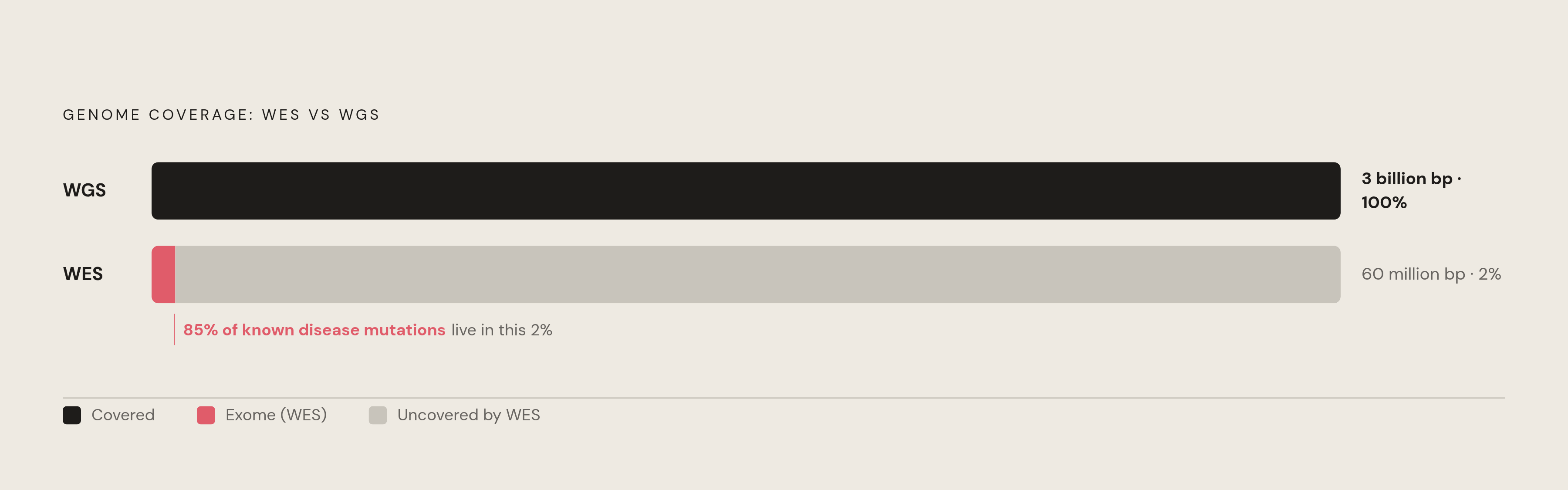
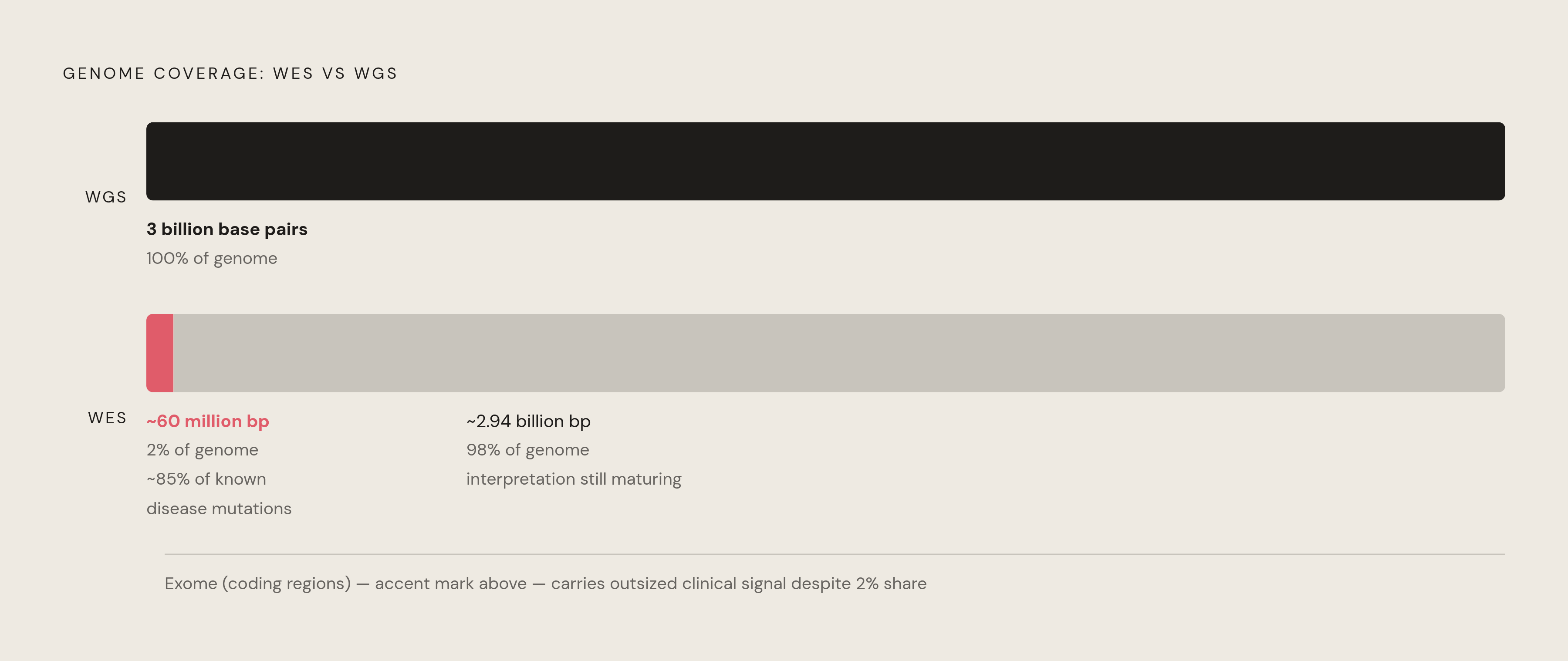
Whole-genome sequencing and exome sequencing both read your DNA, but they read very different amounts of it, and that gap drives almost everything else: cost, the number of ambiguous results you'll have to sit with, and what a healthy person can actually expect to learn. WGS covers all 3 billion base pairs of the human genome, including the introns, the intergenic stretches, and mitochondrial DNA. WES reads only the exome, the protein-coding regions, which adds up to roughly 60 million base pairs, or about 2% of the total genome. That 2% happens to hold something like 85% of known disease-causing mutations, which is exactly why WES became the clinical workhorse it is today, and exactly why the other 98% is worth a second look for anyone without symptoms who's asking "what am I missing" rather than "what's already known to be wrong." The straight answer, argued out below: for most healthy adults without a relevant family history, WES is the better bet right now, and WGS is a bet on infrastructure that hasn't finished arriving.
How the data each test generates differs in scale and what that costs to handle
WGS produces about 90 gigabytes of raw data per sample. WES produces about 10. That's not a rounding difference, it's nearly a ninefold gap, and it doesn't stay contained to a hard drive somewhere. It compounds at every downstream step: storage costs more, processing takes longer, variant calling gets heavier, and the interpretation and counseling time needed to make sense of it all scales up right along with it.
More data doesn't mean more answers, though. It mostly means more variants of uncertain significance, an unexplained signal that shows up on the report without a clear cause behind it. For a healthy adult with no clinical indication prompting the test in the first place, most of that extra 80 gigabytes lacks the context that would make it mean anything. That gap in usable signal is a big part of why WES has historically run a fraction of the cost of WGS, and why the cost difference still matters even as sequencing prices in general keep falling.
What sequencing actually costs a healthy adult in 2024–2025, beyond the sticker price
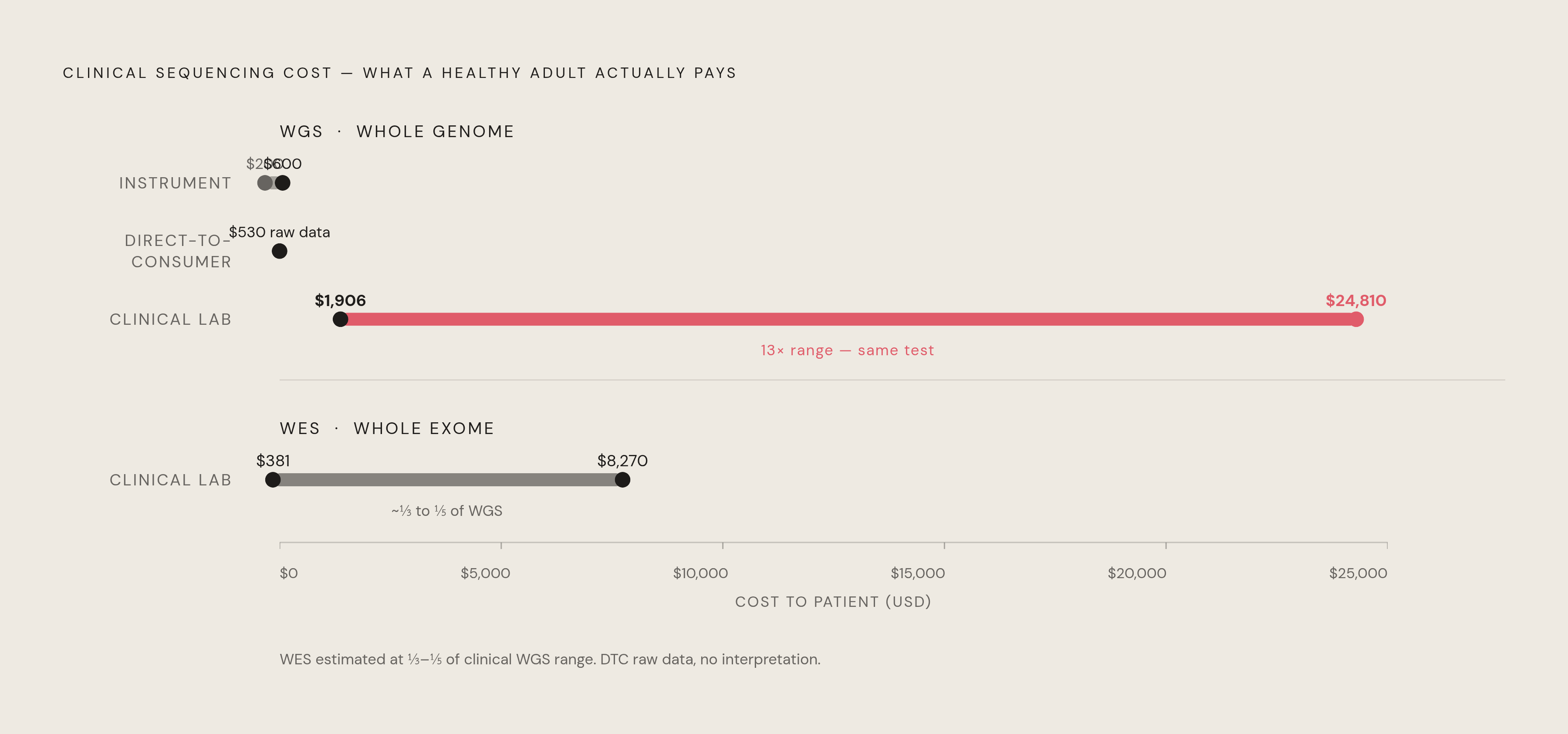
The instrument-level cost of sequencing a genome has collapsed. At the close of the Human Genome Project in 2003, it ran around $3 billion. By 2024, that figure had fallen to roughly $600, and Illumina has claimed it can go as low as $200. Numbers like that make for a great headline, but they don't reflect what a healthy adult actually pays, and treating them as the real price is the first mistake most people make walking into this decision.
Clinical lab pricing for WGS ranges from $1,906 to $24,810: a factor of thirteen between the low and high end for what is nominally the same test. Direct-to-consumer WGS runs as low as $530, but that price buys raw data, not a clinical interpretation; nobody's calling to explain what any of it means. WES has historically cost roughly a third to a fifth of WGS at the clinical lab level. That ratio is shrinking as WGS prices drop, but the gap is still real money, and real money is exactly what a healthy adult with no diagnosis to justify the expense has to reckon with.
Insurance doesn't help much here, either. As of late 2025, insurance coverage for WGS is largely limited to clinical indications, not asymptomatic adults who just want to know things. Both tests are, for the overwhelming majority of healthy adults, an out-of-pocket expense, and that number has to include genetic counseling, which is in short supply relative to demand, plus whatever follow-up testing a finding might trigger.
What the diagnostic yield evidence actually shows, and why it doesn't translate directly to healthy adults
Most of the yield data available comes from clinically referred, symptomatic populations: rare disease patients, children with congenital anomalies, people tested because something was already wrong. WES diagnostic yield in that literature ranges from 25% to 58%, and a large study covering 18,994 referred patients landed on an overall rate of 31.8%. A 2025 meta-analysis pooling 108 studies and 24,631 probands found genome-wide sequencing produced a diagnosis in 34.2% of cases, versus 18.1% for non-genome-wide testing.
In head-to-head comparisons of WGS against WES specifically, WGS yielded 30.6% versus WES's 23.2%. But in unselected cohorts, where nobody was pre-screened for likely genetic disease, WGS's edge over WES shrinks to something like a 1.2-fold advantage, and most of that edge comes from structural variants and non-coding regions where the science of what's clinically meaningful is still being written in real time.
Here's the catch a healthy adult needs to hold onto: these percentages describe people referred for testing because doctors already suspected something genetic was going on. A person with no symptoms starts from a far lower prior probability of carrying an actionable variant, so the yield numbers above aren't the right yardstick to hold this decision against. What they do confirm is that WGS finds more variants than WES. Whether more of those variants are actionable in a screening context, for someone with no symptoms, is a separate and largely unanswered question, and conflating the two is where a lot of the marketing around WGS quietly slips past the evidence.
What genomic screening has actually found in healthy adults: a small but instructive body of evidence
The evidence base for genomic screening in healthy people is thin, but not nothing. A 2015 pilot study of 25 healthy adults using WES found that 24% carried significant, management-changing variants in cancer predisposition genes or ACMG-reportable cardiac conditions. More strikingly, more than 80% of those 25 participants carried variants tied to FDA guidance on drug dosing, meaning their bodies process certain medications differently than the standard dose assumes.
Worth flagging plainly: n=25 is a small sample, the study is a decade old, and participants weren't drawn at random from the general population, so none of this should be read as a population-wide estimate. The pharmacogenomic finding, though, travels better than the cancer and cardiac numbers, because it doesn't depend on which test you pick. Both WES and WGS capture the coding variants that drive drug metabolism; on pharmacogenomics, the two tests are functionally tied, so nobody should pay the WGS premium for this particular benefit alone.
The cancer and cardiac results point toward exactly what the ACMG secondary findings framework, covered next, was built to catch. Currently, a minority of people tested return a positive result for at least one ACMG secondary finding, and the majority test negative. That's the honest baseline to set expectations against: most people who get tested will not find a landmine, and that's the point, not a disappointment.
What the ACMG secondary findings framework covers and what each test can return within it
The American College of Medical Genetics and Genomics maintains a list, currently version 3.3 as of 2025, of 84 genes recommended for secondary findings analysis, applicable to both exome and genome tests. The categories break down into hereditary cancer predisposition syndromes, cardiovascular disease, and inborn errors of metabolism, the common thread being that each has an established surveillance or intervention protocol once you know it's there.
On this particular list, WES is not at a structural disadvantage; both tests can return findings from those 84 genes without issue. That's worth sitting with, because it undercuts the assumption that WGS is simply the superior version of WES with extra credit attached. Where WGS actually pulls ahead is on variant types WES structurally cannot see, covered next. ACMG is careful to frame secondary findings reporting as neither diagnostic testing nor population screening: it's a defined, bounded lookup, not a general health scan. The list gets revised periodically, which matters more than it sounds, because it means the value of a stored genome can grow over time without anyone drawing more blood.
The variant types WGS detects that WES cannot, and how much that matters right now for healthy adults
WGS catches three categories WES structurally cannot: structural variants, pathologic short tandem repeats (the kind of repeat expansion behind conditions like Huntington's and fragile X), and mitochondrial variants. Get any of those from WES and you'd need a separate assay entirely, since the exome simply doesn't include the DNA where they live.
At 75x coverage, WES carries a false-negative rate of 2.17%, compared to 0.022% for WGS at the same depth, so WES misses roughly 2 out of every 100 variants sitting in coding regions that WGS would catch. Zoom out further and the gap gets almost absurd: UK Biobank sequencing found an 18.8-fold increase in observed human variation compared to imputed genotyping arrays, and more than a 40-fold increase compared to WES.
Seeing a variant is not the same as understanding it, though, and that's the whole hinge of this section. For most of that additional non-coding variation, clinical significance hasn't been established yet, so finding it doesn't automatically mean anything actionable follows. Repeat expansions are the cleanest present-day exception, the one place WES genuinely fails a healthy adult outright: conditions like hereditary ataxia or Huntington's can't be ruled out using WES alone, full stop. For someone with no family history of those conditions, that gap is real but the personal stakes are low. For someone who does have that family history, it tips the scale toward WGS decisively, no hedging required. For everyone else, most of what's actually actionable today still lives inside the exome, which is the uncomfortable part for anyone who assumed more data automatically means a better test.
How to weigh the tradeoffs given a healthy adult's actual circumstances
The decision isn't purely technical. It's contextual, and four factors do most of the work in determining which test fits a given person's situation, in roughly this order of importance.
Family history comes first, and it's the clearest tiebreaker in the whole comparison: a family history of conditions caused by structural variants or repeat expansions, hereditary ataxia or certain cardiomyopathies among them, is the strongest single argument for choosing WGS over WES. Budget comes second. With insurance coverage for healthy-adult screening essentially nonexistent, WES's cost advantage, still roughly a third to a fifth of WGS at the clinical level, remains meaningful even as the overall price gap narrows.
Appetite for uncertainty is the third factor, and it gets overlooked constantly. WGS generates more variants of uncertain significance by sheer volume, and someone who finds ambiguous results genuinely stressful isn't well served by a test that hands over more data without more clarity attached. Fourth, and easiest to overlook entirely, is access to genetic counseling. Genetic counselors are in limited supply relative to growing demand, and a test producing a more complicated output with nobody available to walk through it delivers less practical value than a simpler test backed by someone who can actually explain the results.
Consider two people. One wants to know about hereditary cancer and cardiac risk, has a limited budget, no family history involving structural variants, and works with a clinical genetics team that handles exome data routinely; WES fits, and paying extra for WGS here buys mostly uncertainty. The other has a family history involving conditions the coding regions don't capture well, is willing to pay the premium and sit with more complex results, and works with a provider offering longitudinal reanalysis as the science matures; that's the WGS case, and it's the narrower one. Neither test functions as a general health screen. Both return probabilistic information about predisposition, not a diagnosis, and that distinction is easy to lose in the excitement of getting your DNA read at all.
What to expect from the interpretation and follow-up process after either test
Both tests involve pre-authorization logistics if insurance is attempted at all, a process that typically drags on for weeks and almost never succeeds for a healthy-adult screening indication. Worth knowing going in, so nobody's surprised when the claim comes back denied.
Raw data from a $530 DTC WGS test is not a clinical result. It's a file. Turning it into something meaningful requires a separate, paid interpretation service, or a clinician willing to sit down with third-party data and make sense of it, which not all of them are equipped to do. Variants of uncertain significance show up in both tests, and when they do, they require clinical correlation, sometimes testing of family members, and ongoing monitoring as classification databases get updated over the following months and years. Genetic counseling isn't a nice-to-have tacked onto either test; it's the step where a raw finding turns into a surveillance plan, or a conversation with siblings, or a decision about whether to test kids down the line.
One genuine long-term edge for WGS: its data has a longer shelf life for reanalysis. As non-coding variant databases mature, a genome sequenced today could surface new actionable findings five years from now without anyone drawing blood again. WES doesn't offer that for anything outside the exome, because the data for those regions was never captured in the first place. That advantage only holds, though, if the data gets stored properly and the provider actually supports being recontacted later. Stored data that nobody revisits doesn't reanalyze itself, no matter how many gigabytes are sitting on it.
Where the science and infrastructure are heading, and what that means for the timing of this decision
The global WGS market is projected to reach $7.17 billion by 2031, growing at a compound annual rate of 15.2% starting from 2024. Large reference efforts are accelerating the science behind that trend: the NIH's All of Us program has already combined roughly 400,000 whole genome sequences with medical records and aims to reach at least 1 million US participants, while the UK Biobank has sequenced half a million genomes of its own. Every one of those genomes makes the next round of non-coding interpretation a little more reliable.
The UK's National Health Service announced in June 2025 a plan to offer WGS to every newborn within the next decade, part of its 10-Year Health Plan, a fairly clear signal that whole-genome sequencing is heading toward population-scale delivery rather than staying a boutique clinical tool. For a healthy adult deciding today, that puts the two tests in different postures. WES is the lower-cost, lower-complexity option with clinical utility already well established inside the exome. WGS is a bet on the future, one that pays off more as interpretation science catches up to the sequencing capacity that already exists.
That said, there's a real argument for acting now rather than waiting for that future to arrive: actionable secondary findings in cancer and cardiac genes are available and interpretable today, on either test, and delaying a few years for better non-coding databases doesn't change the value of that near-term information one bit. The counterargument holds too, since WGS prices will keep falling and its advantage over WES for healthy adults looks likely to grow rather than shrink as reference databases mature. But absent a family history pointing specifically at structural variants or repeat expansions, the case for paying the WGS premium today rests more on optimism about where the science is going than on what it can currently tell a healthy person. Patience isn't costing this decision much; impatience might cost real money for data nobody can interpret yet.